1.9 million people suffering from chronic kidney disease (CKD) and only 60 dialysis centers serving the entire nation, access to life-saving kidney treatment remains a critical challenge. If you’re a hospital administrator, healthcare entrepreneur, or medical professional looking to establish or upgrade dialysis services in Nepal, this comprehensive guide will help you navigate the complex landscape of dialysis equipment procurement, setup, and operation.
As Nepal’s trusted medical equipment supplier, Nepali Prabidhi has partnered with dozens of hospitals and dialysis centers across Kathmandu, Pokhara, Chitwan, and Birgunj to bring quality kidney care closer to patients who need it most.
 Direct Consultation: For personalized dialysis center planning and equipment guidance, contact our specialists at 9820267438 / 9851400020 or email info@nepaliprabidhi.com
 Complete Guide Navigation
Understanding Nepal’s Kidney Disease Crisis: Why Dialysis Infrastructure Matters
The numbers tell a sobering story. Nepal currently has:
-
- 1.9 million people living with chronic kidney disease (CKD)
-
- 11% urban prevalence rate of CKD in major cities
-
- Only 60 operational dialysis centers nationwide
-
- Approximately 570 dialysis machines serving the entire country
-
- Just 56 qualified nephrologists for a population of 30 million
-
- 3,775 registered dialysis patients requiring regular treatment
-
- Over 85% of kidney patients in rural areas lack access to dialysis
This massive gap between need and availability has created what health experts call a “silent epidemic.” Thousands of Nepali patients travel to India for treatment each year, spending precious resources while their condition deteriorates during travel. The Nepal government recognized this crisis and launched a free dialysis program in 2016, but infrastructure and equipment shortages remain the primary bottleneck.
The Growing Demand for Dialysis Services
Several factors contribute to Nepal’s rising kidney disease burden:
Diabetes & Hypertension Epidemic
With urbanization and lifestyle changes, diabetes and high blood pressure—the two leading causes of kidney failure—are affecting younger Nepalis. Studies show that 60% of CKD patients in Nepal have diabetes as an underlying condition.
Late Diagnosis
Most kidney disease cases go undetected until stage 4 or 5, when dialysis becomes necessary. Nepal lacks widespread screening programs, particularly in rural areas.
Geographic Barriers
Hill and mountain regions have virtually no dialysis facilities. Patients from districts like Humla, Dolpa, and Mugu must travel 2-3 days to reach the nearest center in Kathmandu or Pokhara.
Economic Impact
Private dialysis sessions range from affordable to premium depending on the facility. Even with government subsidies, indirect costs (transportation, lost wages, family support) create significant burden on families.
This is why expanding dialysis infrastructure isn’t just a healthcare priority—it’s a social and economic imperative. Every new dialysis center potentially saves hundreds of lives while keeping treatment costs local.
For hospitals and healthcare entrepreneurs looking to make a difference, establishing dialysis services represents both a meaningful social contribution and a sustainable healthcare business model. Our team at Nepali Prabidhi has helped numerous facilities navigate this journey successfully.
What is Dialysis? Understanding Kidney Dialysis Equipment
Dialysis is a medical procedure that artificially filters waste products, excess fluids, and toxins from blood when kidneys can no longer perform this vital function. In simple terms, a dialysis machine acts as an “artificial kidney” (कृत्रिम मृगौला in Nepali), taking over the job of cleaning blood.
How Dialysis Machines Work: The Technical Process
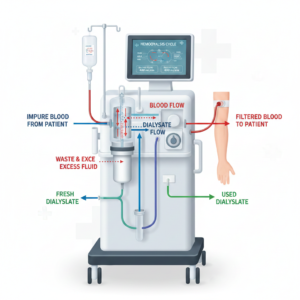
A dialysis machine performs a complex, precise process:
Step 1: Blood Extraction
Blood is drawn from the patient’s body through a surgically created arteriovenous (AV) fistula or central venous catheter at a controlled rate (typically 200-500 ml/minute).
Step 2: Filtration Through Dialyzer
The blood passes through a dialyzer—a specialized filter containing thousands of hollow fiber membranes. These semi-permeable membranes allow small molecules (waste products, excess potassium, urea, creatinine) to pass through while retaining essential blood cells and proteins.
Step 3: Dialysate Circulation
Simultaneously, a specially formulated fluid called dialysate flows on the other side of the membrane in the opposite direction. This counter-current flow maximizes waste removal through diffusion and osmosis.
Step 4: Ultrafiltration
The machine precisely controls pressure to remove excess fluid from the blood—a process called ultrafiltration. This is critical for patients who can no longer urinate adequately.
Step 5: Clean Blood Return
The filtered blood is continuously returned to the patient’s body through the venous line, completing the circuit.
A typical hemodialysis session lasts 3-4 hours and must be repeated 3 times per week. During this time, the machine monitors multiple parameters continuously: blood flow rate, dialysate composition, temperature, pressure, and safety indicators.
Why Quality Dialysis Equipment is Non-Negotiable
Unlike many medical devices, dialysis machines operate at the boundary between life and death. Equipment failure, contamination, or malfunction during treatment can be immediately life-threatening. This is why:
 Choosing certified, reliable equipment is paramount Proper water treatment systems are absolutely essential Regular maintenance and calibration cannot be postponed Trained technical staff must be available during all sessions Backup systems and protocols are mandatory
At Nepali Prabidhi, we only supply equipment that meets international safety standards and provide comprehensive training and support through our medical equipment services division.
Types of Dialysis Machines Available in Nepal
Nepal’s dialysis landscape includes several equipment categories, each suited for different clinical settings and patient needs.
1. Hemodialysis Machines (मुख्य डायलिसिस मेसिन)
The most common type in Nepal, used in 95% of dialysis centers.
Basic Hemodialysis Machines
-
- Ideal for: Small clinics, rural hospitals, government centers
-
- Features: Single pump system, basic volumetric control, standard monitoring
-
- Capacity: Handles 8-15 patients daily per machine
-
- Best for: Starting dialysis services in underserved areas
-
- Investment level: Entry-level to mid-range
Standard Hemodialysis Machines
-
- Ideal for: District hospitals, medium-sized dialysis centers
-
- Features: Dual pump, touchscreen interface, comprehensive monitoring, data logging
-
- Capacity: 15-20 patients daily with proper scheduling
-
- Best for: Established centers with growing patient base
-
- Currently used in: Most private hospitals in Kathmandu Valley
-
- Investment level: Mid-range
High-Flux Dialysis Machines
-
- Ideal for: City hospitals, specialized nephrology centers
-
- Features: Advanced membrane technology, better clearance of middle molecules, shorter treatment times
-
- Capacity: Premium patient care with improved outcomes
-
- Best for: Long-term dialysis patients, diabetic patients
-
- Used in: Bir Hospital, TUTH, Nepal Mediciti, Grande Hospital
-
- Investment level: Mid to high-range
Hemodiafiltration (HDF) Machines
-
- Ideal for: Premium dialysis centers, teaching hospitals
-
- Features: Combines hemodialysis and hemofiltration, highest toxin clearance rates
-
- Capacity: Best-in-class patient outcomes
-
- Best for: Patients requiring superior treatment quality
-
- Used in: Top-tier private hospitals in Kathmandu
-
- Investment level: High-range
Portable/Home Dialysis Machines
-
- Ideal for: Home dialysis programs, ambulatory care
-
- Features: Compact design, simplified operation, patient-friendly interface
-
- Capacity: Enables home-based treatment
-
- Best for: Stable patients seeking independence
-
- Growing adoption in: Urban Nepal among educated patient families
-
- Investment level: Mid to high-range
2. Peritoneal Dialysis (PD) Systems (पेरिटोनियल डायलिसिस)
Less common in Nepal but growing in acceptance, especially for home-based treatment.
Manual CAPD (Continuous Ambulatory PD)
-
- Simplest form of peritoneal dialysis
-
- No machine required—uses gravity
-
- 4-5 exchanges daily
-
- Best for: Rural patients, those unable to travel
-
- Investment level: Minimal (supplies only)
Automated PD Cycler Machines
-
- Performs exchanges automatically at night
-
- Freedom during daytime
-
- Better suited for working patients
-
- Growing in: Urban Nepal
-
- Investment level: Entry to mid-range
For comprehensive information about our complete range of equipment, visit our medical equipment shop.
Essential Components & Technical Requirements of Dialysis Systems
Understanding the complete dialysis ecosystem is crucial for anyone planning to establish or upgrade services.
Core Machine Components
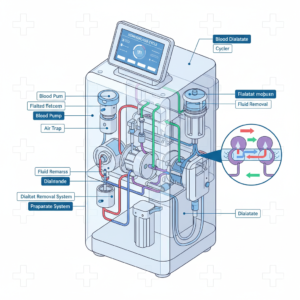
1. Blood Pump System
-
- Peristaltic pump ensuring consistent blood flow
-
- Adjustable rates: 200-500 ml/minute
-
- Flow sensors with real-time monitoring
-
- Occlusion detection for safety
2. Dialyzer (Artificial Kidney Filter)
-
- Hollow fiber membrane filter (12,000-15,000 fibers)
-
- Surface area: 1.0-2.5 square meters
-
- Single-use consumable (cannot be reused in Nepal as per health ministry guidelines)
-
- Different sizes for adult, pediatric, and body weight considerations
3. Dialysate Preparation & Delivery System
-
- Automatic mixing of concentrate and treated water
-
- Precise conductivity control (13-16 mS/cm)
-
- Temperature regulation (35-37°C)
-
- Bicarbonate-based or acetate-based systems
4. Ultrafiltration Control System
-
- Volumetric control for fluid removal
-
- Transmembrane pressure monitoring
-
- Adjustable UF rates (0-2000 ml/hour)
-
- Critical for preventing over/under-hydration
5. Multi-Parameter Monitoring
-
- Arterial/venous pressure sensors
-
- Air bubble detectors
-
- Blood leak detectors
-
- Temperature probes
-
- Conductivity meters
-
- Flow rate monitors
6. Safety & Alarm Systems
-
- Visual and audible alarms
-
- Automatic blood pump stop on critical alarms
-
- Backup power supply integration
-
- Treatment data recording
Critical Supporting Infrastructure
Water Treatment System (Reverse Osmosis Plant)
This is often overlooked but absolutely essential. Dialysis requires ultra-pure water—tap water in Nepal contains contaminants that would be fatal if introduced into the bloodstream.
Requirements for Nepal:
-
- Input water TDS: 200-500 ppm (typical Kathmandu tap water)
-
- Output water TDS: <10 ppm (mandatory)
-
- Bacterial count: <200 CFU/ml
-
- Endotoxin level: <2 EU/ml
-
- Production capacity: 500-1500 liters per hour depending on machine count
Components needed:
-
- Multi-stage pre-filtration (sediment, carbon, softener)
-
- Dual-pass RO membranes
-
- UV sterilization
-
- Storage tank with recirculation
-
- Distribution loop to each machine
-
- Regular water quality testing equipment
Investment for RO Plant: Entry-level to mid-range depending on capacity
Electrical Infrastructure
Nepal’s power challenges make this critical:
-
- Dedicated electrical panel (400A for 10-machine center)
-
- Voltage stabilizers (essential in Nepal!)
-
- UPS/Inverter backup (minimum 4 hours for active sessions)
-
- Generator with auto-changeover (highly recommended)
-
- Power consumption: 800-1500W per machine
Space Requirements
Proper planning prevents costly retrofitting:
-
- Treatment area: 40-50 sq ft per dialysis station
-
- RO plant room: 200-400 sq ft
-
- Storage for consumables: 150-200 sq ft
-
- Staff station and records: 100-150 sq ft
-
- Waiting area: 20-30 sq ft per station
-
- Patient restrooms: Wheelchair accessible
-
- Emergency supplies storage
For complete turnkey dialysis center setup, explore our setup solutions.
Government Free Dialysis Program in Nepal: What Healthcare Providers Should Know
The Nepal Government launched the Free Dialysis Treatment Program in 2016 (Fiscal Year 2072/73), marking a significant milestone in public health policy.
Program Overview
Eligibility:
-
- All Nepali citizens with End-Stage Renal Disease (ESRD)
-
- No income or insurance restrictions
-
- Available at designated government hospitals
Coverage:
-
- Three hemodialysis sessions per week
-
- Essential dialysis consumables (dialyzers, blood lines, saline)
-
- Basic medications (heparin, EPO in some centers)
-
- Emergency dialysis services
Designated Hospitals:
-
- Bir Hospital, Kathmandu
-
- Tribhuvan University Teaching Hospital (TUTH)
-
- Patan Hospital
-
- Provincial hospitals in all 7 provinces
-
- Select district hospitals
Challenges in Implementation
Despite good intentions, the program faces hurdles:
Limited Capacity
Government hospitals have insufficient machines for demand. Waiting times can be weeks or months.
Geographic Concentration
Most free facilities are in Kathmandu Valley, leaving rural populations underserved.
Quality Concerns
Overworked machines and shortage of supplies sometimes affect treatment quality.
This Creates Opportunity for Private Sector
Private dialysis centers play a complementary role:
-
- Absorbing overflow from government facilities
-
- Providing services in underserved regions
-
- Offering premium care options
-
- Creating employment for healthcare workers
Many private centers offer subsidized rates or charity beds to support patients who cannot afford fully private care, creating a blended model that serves Nepal’s diverse socioeconomic population.
If you’re establishing a dialysis center with a social mission, we can help design a sustainable model. Contact our team through the consultation page.
How to Choose the Right Dialysis Equipment for Your Facility
Selecting appropriate equipment requires balancing clinical needs, patient demographics, budget realities, and long-term sustainability.
Assessment Framework
1. Define Your Patient Profile
For Rural/District Hospitals:
-
- Basic hemodialysis machines
-
- Focus on reliability over features
-
- Simple operation for limited staff
-
- Robust design for challenging conditions
For Urban Multi-Specialty Hospitals:
-
- Mix of standard and high-flux machines
-
- Advanced monitoring capabilities
-
- Integration with hospital information systems
-
- Suitable for complex patients (diabetes, elderly, comorbidities)
For Specialized Dialysis Centers:
-
- High-flux or HDF machines
-
- Premium patient experience
-
- Data management systems
-
- Home dialysis program support
2. Calculate Patient Volume
Be realistic about initial patient load and growth projections:
-
- 5-10 patients/day: 2-3 machines (allows for maintenance/rotation)
-
- 15-25 patients/day: 5-8 machines (typical district hospital)
-
- 30-50 patients/day: 10-15 machines (full dialysis center)
-
- 50+ patients/day: 15-20+ machines (major nephrology center)
Pro tip: Start with 60-70% of projected capacity and add machines as patient base grows. Over-investing in equipment that sits idle doesn’t serve anyone.
3. Evaluate Technical Support Infrastructure
Critical questions:
-
- Is there a service center in Nepal for your chosen brand?
-
- Can spare parts be sourced within 24-48 hours?
-
- Is there a trained biomedical engineer on the supplier’s team?
-
- What is the average response time for breakdowns?
In Nepal’s context, a slightly lower-spec machine from a brand with strong local support often outperforms a premium machine from a brand with no Nepal presence.
4. Consider Total Cost of Ownership (TCO)
Look beyond initial purchase:
Initial Investment:
-
- Machines (varies by type and quantity)
-
- RO plant and water treatment
-
- Furniture (dialysis chairs, beds)
-
- Installation and commissioning
-
- Staff training
Monthly Operational Costs per Machine:
-
- Consumables (dialyzers, blood lines, needles)
-
- Water and electricity
-
- Staff salaries
-
- RO membrane and filter replacement
-
- Regular maintenance
Annual Maintenance:
-
- AMC (Annual Maintenance Contract)
-
- Calibration and certification
-
- Spare parts
-
- Software updates
Important: Focus on cost-per-treatment rather than just equipment cost. A more efficient machine with lower consumable costs may offer better TCO despite higher upfront investment.
5. Verify Certifications & Compliance
Essential certifications: CE Mark (European safety certification) ISO 13485 (Medical device quality management) FDA approval (for US-manufactured equipment) Nepal Medical Device Registration (from Department of Drug Administration) ISO 11663 (Hemodialysis equipment performance standard)
6. Plan for Nepal’s Unique Challenges
Power Reliability:
-
- Machines with built-in battery backup for alarms
-
- Integration with UPS/inverter systems
-
- Ability to resume treatment after brief interruptions
Water Quality:
-
- Robust pre-filtration before RO plant
-
- Systems tolerant of fluctuating input water quality
-
- Easy access to RO membranes and spare parts in Nepal
Climate Considerations:
-
- Equipment rated for Nepal’s temperature range (5-40°C)
-
- Humidity tolerance (especially for monsoon season in Terai)
-
- Dust protection (critical in Kathmandu)
Staff Training Levels:
-
- Intuitive interface for less experienced staff
-
- Comprehensive local language support
-
- Extensive training programs included
For a detailed consultation on choosing equipment for your specific context, our technical team offers free site assessments. Learn more about our equipment consultation services.
Top International Dialysis Machine Brands Available in Nepal
Nepal’s dialysis market features equipment from globally respected manufacturers, each with distinct strengths.
Premium International Brands
Fresenius Medical Care (Germany) 
-
- Global leader: World’s largest dialysis company, treating over 340,000 patients daily worldwide
-
- Presence in Nepal: Limited but growing, mainly in high-end private hospitals
-
- Popular models: 4008S, 5008S, 6008 CAREsystem
-
- Strengths: Exceptional build quality, comprehensive safety features, extensive clinical evidence
-
- Considerations: Premium positioning, spare parts must be imported
-
- Best for: Top-tier nephrology centers, teaching hospitals
-
- Used by: Nepal Mediciti, Grande International Hospital
Nipro (Japan) 
-
- Market position: Strong presence in South Asian markets
-
- Presence in Nepal: Well-established with good service network
-
- Popular models: Surdial 55, Surdial 75
-
- Strengths: Excellent quality-price ratio, reliable performance, good local support
-
- Considerations: Moderate feature set compared to premium brands
-
- Best for: District hospitals, mid-size private centers, government expansion projects
-
- Used by: Multiple government and private hospitals across Nepal
Nikkiso (Japan)
-
- Market position: Known for innovative technology and user-friendly design
-
- Presence in Nepal: Growing market share, supported by authorized distributors
-
- Popular models: DBB-27, DBB-EXA
-
- Strengths: Advanced technology, excellent patient monitoring, intuitive operation
-
- Considerations: Mid-to-premium pricing
-
- Best for: Urban hospitals, specialized dialysis centers
-
- Used by: Patan Hospital, various Kathmandu clinics
Baxter (USA) 
-
- Specialization: Leader in peritoneal dialysis systems
-
- Presence in Nepal: Small but growing, mainly for home dialysis programs
-
- Popular models: HomeChoice Claria, Amia APD System
-
- Strengths: Excellent PD technology, patient independence, lower center infrastructure requirements
-
- Considerations: Limited hemodialysis product line
-
- Best for: Home dialysis programs, patients suitable for PD
-
- Growing adoption: Urban Nepal, educated patient families
B. Braun (Germany)
-
- Market position: Reliable German engineering, comprehensive product portfolio
-
- Presence in Nepal: Moderate, mainly in established centers
-
- Popular models: Dialog+, Dialog iQ
-
- Strengths: Robust construction, extensive safety features, modular design
-
- Considerations: Premium positioning
-
- Best for: Multi-specialty hospitals, quality-focused centers
Toray Medical (Japan)
-
- Market position: Cost-effective quality option
-
- Presence in Nepal: Emerging presence, popular for new centers
-
- Popular models: TR-8000 series, TR-3000M
-
- Strengths: Good price point, reliable performance, adequate features
-
- Considerations: Less brand recognition than premium competitors
-
- Best for: Budget-conscious facilities, rural expansion, NGO projects
Why Buy Through Authorized Distributors?
The Nepali Prabidhi Difference:
As an authorized distributor, we provide:
Genuine Equipment: Factory-certified products with full manufacturer warranty Complete Documentation: Import licenses, customs clearance, Nepal DDA registration Professional Installation: By certified biomedical engineers following manufacturer protocols Comprehensive Training: Multi-day programs for all staff levels (doctors, nurses, technicians) Parts Availability: Stock of critical spare parts in Kathmandu—no waiting for imports during emergencies 24/7 Technical Support: Nepali-speaking engineers available for troubleshooting Annual Maintenance Contracts: Preventive maintenance, calibration, and priority service Regulatory Compliance: Ensuring all equipment meets Nepal Health Ministry standards
Warning Against Grey Market:
Some suppliers offer dialysis machines at suspiciously low rates. These are often:
-
- Used/refurbished equipment without disclosure
-
- Expired or near-expiry warranty
-
- Unofficial imports without proper registration
-
- No service backup in Nepal
Such equipment may save money initially but creates enormous risk—both legal and clinical. Always verify authorization and documentation.
Check our complete range of ICU and patient monitoring equipment as well.
Complete Dialysis Center Setup Requirements: A Step-by-Step Guide
Establishing a dialysis center in Nepal requires careful planning across clinical, technical, regulatory, and financial dimensions.
Pre-Setup Planning Phase
Market Assessment
-
- Analyze local CKD patient population
-
- Evaluate competition (existing centers within 10 km)
-
- Assess patient affordability levels
-
- Calculate projected patient volume (realistic 6-month, 1-year, 3-year projections)
Location Selection
-
- Accessibility from main roads
-
- Parking for patients and families
-
- Ground floor preferred (wheelchair access critical)
-
- Proximity to hospital for emergency support
-
- Adequate water supply
-
- Stable electricity (or capacity for backup)
Regulatory Requirements
Before purchasing any equipment, understand Nepal’s regulatory framework:
Business Registration:
-
- Company registration (Private Ltd or Partnership)
-
- PAN and VAT registration
-
- Nepal Medical Council notification
Health Ministry Approvals:
-
- Dialysis center operation license from Department of Health Services
-
- Nephrologist on staff (full-time or consultant basis)
-
- Trained dialysis technicians (minimum 1 per 3 machines)
-
- Registered nurses
-
- Biomedical waste management plan
-
- Infection control protocols
Infrastructure Standards:
-
- Minimum area requirements (500 sq ft for 5-machine center)
-
- Separate RO plant room
-
- Medical gas supply (oxygen, backup)
-
- Emergency power backup
-
- Fire safety systems
-
- Wheelchair-accessible facilities
Infrastructure Development
Civil Work:
-
- Treatment area with proper lighting (natural + artificial)
-
- Vinyl/epoxy flooring (easy to clean, infection control)
-
- Washable wall paint or tiles
-
- Air conditioning (maintains stable temperature)
-
- Adequate ventilation
-
- Patient and staff restrooms
Electrical Work:
-
- Three-phase power supply
-
- Dedicated panel for dialysis machines
-
- Separate circuit for RO plant
-
- Emergency lighting
-
- Generator integration with ATS (Automatic Transfer Switch)
-
- UPS for critical equipment
Plumbing Work:
-
- RO plant installation
-
- Distribution pipeline to each machine position
-
- Drainage for RO reject water (environmentally responsible disposal)
-
- Hot water supply for cleaning
-
- Backup water storage tank
Medical Gas:
-
- Oxygen supply (cylinder manifold or centralized)
-
- Suction facility at each station
Equipment Procurement
Essential Equipment:
Core Dialysis Equipment:
-
- Hemodialysis machines (number based on projected volume)
-
- Water treatment system (RO plant)
-
- Water quality testing equipment
-
- Backup dialyzer inventory
Patient Furniture:
-
- Dialysis chairs/beds (one per machine)
-
- Bedside tables
-
- IV stands
-
- Over-bed tables
-
- Waiting room seating
Clinical Support Equipment:
-
- Patient weighing scale (digital, capacity 200kg+)
-
- BP apparatus (manual + automatic)
-
- Pulse oximeter
-
- Emergency crash cart
-
- Oxygen cylinders and flow meters
-
- Suction machine
Storage & Utilities:
-
- Refrigerator for medication storage
-
- Autoclave or sterilizer
-
- Storage cabinets for consumables
-
- Dirty utility area
-
- Linen storage
IT Infrastructure:
-
- Computer system for patient records
-
- Printer
-
- Internet connectivity
-
- Patient management software (optional but recommended)
For complete hospital furniture and setup solutions, we offer comprehensive packages.
Consumables & Supplies Stocking
Per-Session Consumables (for each patient treatment):
-
- Dialyzer (artificial kidney)
-
- Blood line set (arterial + venous)
-
- AV fistula needles (2 per session)
-
- Saline (500ml – 1000ml)
-
- Heparin (anticoagulant)
-
- Alcohol swabs, gauze, tape
-
- Gloves, masks, aprons (infection control)
Initial Stock Recommendations:
-
- 3 months supply of dialyzers (multiple sizes)
-
- 2 months of blood lines and needles
-
- Emergency backup stock
-
- Relationship with reliable medical consumables supplier
Staffing Requirements
Clinical Staff:
-
- Medical Director (Nephrologist) – 1
-
- Staff Nurses – 1 per 3-4 machines per shift
-
- Dialysis Technicians – 2-3 (for machine operation)
-
- Support Nurses/Aides – 1-2
-
- Pharmacist – 1 (part-time acceptable for small centers)
Technical Staff:
-
- Biomedical Engineer/Technician – 1
-
- RO Plant Operator – 1 (can be combined with maintenance role)
Administrative Staff:
-
- Center Manager
-
- Receptionist/Billing
-
- Housekeeping
-
- Security (especially for night shifts if applicable)
Total staff for 10-machine center: 12-15 people
Financial Planning
Capital Investment Components:
Equipment & Infrastructure:
-
- Dialysis machines
-
- RO water treatment plant
-
- Furniture and patient amenities
-
- Civil, electrical, plumbing work
-
- IT systems
-
- Initial consumables stock
Typical Investment Ranges for Different Scales:
Micro Center (2-3 machines): Entry-level investment
-
- Suitable for: Rural areas, satellite clinics
-
- Break-even: 18-24 months with good patient load
Small Center (5-8 machines): Mid-range investment
-
- Suitable for: District hospitals, semi-urban areas
-
- Break-even: 24-30 months
Standard Center (10-15 machines): Substantial investment
-
- Suitable for: City locations, standalone dialysis centers
-
- Break-even: 30-36 months
Large Center (15+ machines): Significant investment
-
- Suitable for: Metro areas, integrated with hospital
-
- Break-even: 36-48 months
Working Capital:
-
- 3-6 months operating expenses
-
- Staff salaries
-
- Consumables
-
- Utilities
-
- Marketing
Revenue Streams & Sustainability
Primary Revenue:
-
- Per-session charges (varies by patient category)
-
- Government referral patients (if empaneled)
-
- Insurance-covered patients
-
- Direct-pay patients
Typical Patient Mix in Nepal:
-
- 30-40%: Government-referred or subsidized
-
- 20-30%: Insurance-covered
-
- 30-50%: Out-of-pocket direct pay
Ancillary Revenue:
-
- Consultation fees (nephrologist visits)
-
- Laboratory tests
-
- Pharmacy sales (EPO, iron supplements, phosphate binders)
-
- Home dialysis equipment rental/sales
Financial Sustainability Tips:
-
- Mix of patient categories (don’t rely 100% on one type)
-
- Efficient consumables management
-
- Preventive maintenance to avoid equipment downtime
-
- Staff retention (training is expensive)
-
- Patient satisfaction (builds referral base)
For detailed financial modeling and business planning support, our team offers free consultations. Visit our enquiry page.
Installation, Training & Ongoing Support in Nepal
Success of a dialysis center depends not just on equipment but on people—trained, confident staff who can operate complex machines safely and handle emergencies appropriately.
Comprehensive Installation Services
Phase 1: Pre-Installation (1-2 weeks before delivery)
-
- Site inspection by biomedical engineer
-
- Civil work verification
-
- Electrical load testing
-
- Water quality baseline testing
-
- Finalizing machine positions and layout
-
- Pre-delivery checklist completion
Phase 2: Installation & Commissioning (3-5 days)
-
- Equipment delivery and inspection
-
- Physical installation and positioning
-
- RO plant integration
-
- Electrical and plumbing connections
-
- System calibration
-
- Leak testing (water and dialysate)
-
- Pressure testing
-
- Software configuration
-
- Test dialysis run
-
- Documentation and certification
Phase 3: Validation (1 day)
-
- Complete system validation per manufacturer protocol
-
- Water quality testing and certification
-
- Safety systems verification
-
- Data recording systems check
-
- Nepal Health Ministry compliance documentation
Multilevel Training Programs
1. Nephrologist / Medical Director Training (2 days)
-
- Advanced machine features
-
- Treatment protocol programming
-
- Complication management
-
- Quality assurance procedures
-
- Emergency protocols
-
- Regulatory compliance
-
- Documentation requirements
2. Staff Nurse Training (4-5 days)
-
- Machine operation basics
-
- Patient connection procedures (AV fistula, catheter)
-
- Treatment initiation and monitoring
-
- Parameter adjustment during dialysis
-
- Patient assessment (pre and post-dialysis)
-
- Emergency response (hypotension, muscle cramps, chest pain)
-
- Infection control protocols
-
- Documentation and record-keeping
3. Dialysis Technician Training (5-7 days)
-
- Comprehensive machine operation
-
- Dialysate preparation
-
- System priming and setup
-
- Patient monitoring during treatment
-
- Troubleshooting common issues
-
- Alarm management
-
- Post-dialysis procedures
-
- Machine cleaning and disinfection
-
- Consumables management
-
- RO plant operation basics
4. Biomedical Engineer / Technical Staff Training (7-10 days)
-
- Machine architecture and components
-
- Preventive maintenance procedures
-
- Calibration protocols
-
- Common fault diagnosis
-
- Spare parts replacement
-
- RO plant troubleshooting
-
- Water quality management
-
- Documentation systems
-
- Emergency repairs
-
- When to escalate to manufacturer
5. Support Staff Training (1-2 days)
-
- Infection control basics
-
- Waste management (regular vs biomedical)
-
- Cleaning protocols for dialysis area
-
- Patient safety awareness
-
- Emergency procedures
Training Methodology:
-
- Hands-on practical sessions (60% of time)
-
- Theory and video demonstrations (30%)
-
- Assessment and certification (10%)
-
- Training materials in English and Nepali
-
- Certificates provided upon successful completion
All training delivered at your facility, on your equipment, with your staff—ensuring immediate practical application.
Our training and maintenance programs are customized for Nepal’s healthcare environment.
Ongoing Technical Support
Hotline Support (24/7): 9820267438 / 9851400020
-
- Nepali and English speaking engineers
-
- Remote troubleshooting
-
- Emergency guidance
-
- Spare parts ordering
-
- Consumables procurement
On-Site Service Response:
-
- Kathmandu Valley: Same-day response for critical issues
-
- Pokhara, Chitwan, Birgunj: Within 24 hours
-
- Other urban centers: Within 48 hours
-
- Remote areas: Telephone support + scheduled visits
Preventive Maintenance:
-
- Quarterly on-site visits (minimum)
-
- Comprehensive 50-point checklist
-
- Calibration verification
-
- Wear parts replacement
-
- System performance testing
-
- Water quality assessment
-
- Documentation for regulatory compliance
Annual Maintenance Contract (AMC) Benefits:
-
- All preventive maintenance included
-
- Priority service response
-
- Discounted spare parts (typically 20-30% off)
-
- Free software updates
-
- Annual certification
-
- Performance reports
-
- Regulatory compliance documentation
Spare Parts Inventory in Kathmandu:
-
- Blood pump components
-
- Pressure transducers
-
- Conductivity probes
-
- Temperature sensors
-
- PCB boards and display panels
-
- RO membranes and pre-filters
-
- Dialysate concentrate connectors
-
- Most critical parts available for immediate dispatch
Knowledge Transfer:
-
- Quarterly refresher training sessions
-
- New technology webinars
-
- Best practice workshops
-
- Peer learning opportunities
-
- Access to technical resource library
Addressing Nepal’s Unique Dialysis Challenges
Establishing dialysis services in Nepal presents challenges not commonly encountered in developed healthcare markets. Understanding and planning for these is critical for success.
Challenge 1: Irregular Power Supply
The Problem:
Load shedding, while improved, still affects many parts of Nepal. Voltage fluctuations and sudden power cuts during dialysis can be life-threatening.
Solutions: Mandatory UPS/Inverter: Minimum 4-hour backup capacity Voltage Stabilizers: Protect sensitive electronics Generator with ATS: Automatic changeover in <5 seconds Regular Battery Maintenance: Monthly checks, annual replacement Redundant Power: Critical machines on separate circuits Treatment Scheduling: Avoid peak load-shedding hours when possible
Nepali Prabidhi provides:
-
- Power requirement calculations
-
- UPS sizing and installation
-
- Generator integration support
-
- Electrical safety audits
Challenge 2: Water Quality Variability
The Problem:
Kathmandu’s municipal water varies significantly in quality (TDS, bacterial content, chlorine levels). Monsoon season worsens this. Poor water quality damages RO membranes and can contaminate dialysate.
Solutions: Robust Pre-Filtration: Multi-stage before RO (sediment + activated carbon + softener) Oversized RO Capacity: Design for worst-case water quality Regular Testing: Weekly water quality monitoring Membrane Replacement Schedule: Don’t wait for failure Storage Tank: Reduces dependence on immediate supply quality Bypass Arrangement: Incoming water bypasses during monsoon sediment peaks
Nepali Prabidhi provides:
-
- Water quality testing equipment
-
- Customized RO plant design
-
- Maintenance schedules optimized for Nepal conditions
-
- Quarterly water quality audits (included in AMC)
Challenge 3: Trained Workforce Shortage
The Problem:
Nepal has only 56 nephrologists for 30 million people. Trained dialysis nurses and technicians are even scarcer. Staff turnover is high, especially in rural areas.
Solutions: Comprehensive Training: Go beyond basic machine operation Career Development: Create growth paths for technical staff Competitive Compensation: Retain trained staff Refresher Programs: Quarterly skill updates Cross-Training: Multiple staff can cover each role Partnerships: Link with nursing colleges for internships
Nepali Prabidhi provides:
-
- Initial multi-level training (included in equipment sale)
-
- Annual refresher programs (under AMC)
-
- Emergency re-training if staff turnover occurs
-
- Training materials and protocols
-
- Connection to nursing training institutions
Challenge 4: Spare Parts & Consumables Supply Chain
The Problem:
Most dialysis equipment and consumables are imported. Customs delays, shipping issues, or global supply disruptions can leave centers stranded.
Solutions: Authorized Distributor: Deal with suppliers who stock parts locally Adequate Inventory: 3-month consumables buffer Multiple Suppliers: Don’t depend on single source Relationship Building: Personal connections matter in Nepal business culture Plan Ahead: Order next batch when 40% remain, not when running out
Nepali Prabidhi maintains:
-
- Kathmandu warehouse with critical spare parts
-
- Emergency courier service to centers outside valley
-
- Advance ordering system (prevents stockouts)
-
- Relationships with multiple international suppliers
-
- Quick customs clearance process
Challenge 5: Patient Affordability & Payment
The Problem:
Many patients cannot afford regular dialysis. Even government-subsidized programs have gaps. Centers face payment challenges.
Solutions: Tiered Pricing: Different rates for different patient categories Charity Beds: 10-20% capacity reserved for subsidized patients Insurance Empanelment: Partner with government and private insurance Payment Plans: Installment options for regular patients NGO Partnerships: Connect with kidney foundations Transparent Pricing: Build trust through clear communication
Nepali Prabidhi supports:
-
- Business model consultation
-
- Financial planning assistance
-
- Connection to potential funding sources (CSR, NGOs)
-
- Efficiency improvements to reduce cost-per-treatment
Challenge 6: Geographic Isolation
The Problem:
Patients from hill and mountain districts must travel days to reach dialysis centers, often impossible for thrice-weekly treatment.
Solutions: Decentralized Model: Encourage dialysis centers in district hospitals Home Dialysis Programs: Peritoneal dialysis for suitable patients Telemedicine: Remote monitoring and consultation Patient Hostels: Accommodation near centers for distant patients Mobile Dialysis: Exploring feasibility for Nepal context
Nepali Prabidhi supports:
-
- Feasibility studies for rural centers
-
- Compact/portable equipment for smaller facilities
-
- Home dialysis program setup
-
- Telemedicine infrastructure consultation
Frequently Asked Questions About Dialysis in Nepal
 How many dialysis centers are there in Nepal?
As of 2026, Nepal has approximately 60 operational dialysis centers with around 570 dialysis machines serving the entire country. About 45% of centers are in Kathmandu Valley, with the remaining distributed across provincial capitals and some district headquarters. The government is actively working to expand this network, particularly in underserved regions.
Is dialysis free in Nepal?
Yes and no. The Nepal Government Free Dialysis Program (launched 2016) provides free hemodialysis at designated government hospitals including Bir Hospital, TUTH, Patan Hospital, and select provincial hospitals. This covers the dialysis procedure and basic consumables for eligible Nepali citizens. However:
-
- Private hospital dialysis is not free (out-of-pocket payment required)
-
- Waiting times at free centers can be long due to capacity constraints
-
- Some medications and additional tests may not be covered even in government facilities
-
- Transportation and indirect costs are patient responsibility
Many private centers offer subsidized rates or charity beds for economically disadvantaged patients.
Which is better for Nepal patients – hemodialysis or peritoneal dialysis?
The answer depends on individual circumstances:
Hemodialysis is better for:
-
- Patients near dialysis centers
-
- Those who prefer center-based care
-
- Patients with unstable conditions requiring close monitoring
-
- Majority of patients (more established practice in Nepal)
Peritoneal dialysis is better for:
-
- Patients in remote areas far from centers
-
- Those wanting independence and home-based treatment
-
- Employed individuals needing flexible schedules
-
- Patients with suitable peritoneal membrane and no abdominal complications
Peritoneal dialysis is underutilized in Nepal but offers significant advantages for appropriate patients, especially in rural and hill regions. A good nephrologist will assess individual suitability.
What qualifications are needed to operate a dialysis center in Nepal?
Minimum Requirements:
-
- Medical Director: MD in Nephrology (full-time or consultant with minimum hours)
-
- Dialysis Nurses: Registered Nurses with specialized dialysis training
-
- Dialysis Technicians: Certificate in dialysis technology or trained nursing support staff
-
- Biomedical Engineer/Technician: For equipment maintenance
-
- License from Nepal Department of Health Services
-
- Nepal Medical Council notification
-
- Proper infrastructure meeting health ministry standards
Staff training can be arranged through equipment suppliers like Nepali Prabidhi, who provide comprehensive multi-level programs during installation.
How often do dialysis machines need servicing?
Comprehensive maintenance schedule:
-
- Daily: Pre-treatment checks by technician (30 minutes)
-
- Weekly: Disinfection of all fluid pathways
-
- Monthly: RO plant membrane cleaning and water quality testing
-
- Quarterly: Preventive maintenance by biomedical engineer (3-4 hours per machine)
-
- Annually: Complete calibration, parts replacement, certification
Skipping maintenance is dangerous and dramatically shortens equipment life. An Annual Maintenance Contract (AMC) from your supplier typically includes all quarterly and annual services, spare parts, and priority emergency support.
Can we buy refurbished/second-hand dialysis machines for Nepal?
Technically yes, but with significant caveats:
If considering refurbished equipment: Verify complete service history and age (ideally <5 years old) Ensure certification from qualified biomedical engineer Confirm warranty coverage (minimum 12 months) Check spare parts availability in Nepal Verify compliance with current safety standards Confirm Nepal Health Ministry will approve registration
Risks of informal/uncertified used equipment: Unknown maintenance history Potential safety issues Difficulty getting Nepal registration No manufacturer support or warranty May not meet current regulatory standards Could create liability issues
Our recommendation: New equipment from authorized suppliers, unless you’re working with a reputable refurbisher who provides full certification and warranty. Nepali Prabidhi occasionally has certified pre-owned equipment from hospital upgrades—tested, warranted, and fully supported.
What is the typical lifespan of a dialysis machine in Nepal conditions?
Expected Lifespan:
-
- Premium brands (Fresenius, B.Braun): 12-15 years with proper maintenance
-
- Mid-tier brands (Nipro, Nikkiso): 10-12 years
-
- Entry brands (Toray): 8-10 years
In Nepal specifically:
Lifespan can be shortened by:
-
- Irregular maintenance
-
- Power surges (if not using stabilizers/UPS)
-
- Poor water quality (damages internal components)
-
- Overuse (running 24/7 without proper rest)
-
- Inadequate staff training (operator errors)
To maximize lifespan: Invest in robust electrical protection Maintain excellent water treatment Follow manufacturer maintenance schedule religiously Keep detailed service records Train staff properly Have AMC with authorized service provider
Well-maintained machines in Nepal routinely reach or exceed their expected lifespan.
What happens during power cuts while a patient is on dialysis?
This is a critical safety concern in Nepal’s context. Here’s what happens:
With Proper Backup (Mandatory):
-
- UPS/Inverter immediately takes over (<1 second switchover)
-
- Dialysis continues uninterrupted
-
- All alarms and monitoring remain functional
-
- Patient completely safe
-
- If power out >4 hours, can safely disconnect patient
Without Proper Backup (EXTREMELY DANGEROUS):
-
- Machine stops immediately
-
- Blood outside patient’s body cannot be returned
-
- Patient at risk of severe complications
-
- Emergency manual procedures required
-
- Potential loss of vascular access
-
- Medical emergency situation
This is why: UPS/inverter backup is mandatory, not optional Regular backup system testing is critical Generator integration highly recommended for larger centers Never schedule dialysis during known outage periods Emergency manual protocols must be established and practiced
Nepali Prabidhi includes power backup planning in all dialysis center installations.
Is there financing available for dialysis equipment in Nepal?
Yes, several options exist:
Bank Financing:
-
- Most commercial banks offer healthcare equipment loans
-
- Interest rates: 10-14% (varies by bank and borrower profile)
-
- Loan period: 5-7 years typically
-
- Collateral: Usually equipment + property
-
- Processing time: 2-4 weeks
Vendor Financing:
-
- Some international manufacturers offer direct financing programs
-
- May have more favorable terms than local banks
-
- Limited availability in Nepal market
Investment Partnerships:
-
- Co-investment with hospital groups
-
- Partnership with nephrologists
-
- Private equity (for larger projects)
Government Programs:
-
- Nepal Government occasionally announces subsidized loan programs for healthcare infrastructure
-
- Targeted support for rural/underserved areas
Grant Opportunities:
-
- International health NGOs
-
- Kidney foundations
-
- Corporate CSR programs
Nepali Prabidhi can connect you with appropriate financing sources and assist with business planning and loan applications. We’ve helped numerous centers successfully secure funding.
How do we ensure infection control in dialysis center?
Infection control is paramount—dialysis patients are immunocompromised and share treatment space. Nepal Health Ministry has specific guidelines:
Standard Precautions:
-
- Hand hygiene before and after every patient contact
-
- Personal protective equipment (gloves, masks, gowns)
-
- Safe injection practices
-
- Aseptic technique for all invasive procedures
Environmental Controls:
-
- Daily cleaning of all surfaces with appropriate disinfectants
-
- Terminal cleaning between shifts
-
- Proper medical waste segregation (yellow bags, sharps containers)
-
- Regular HVAC filter changes
-
- Pest control
Equipment-Related:
-
- Single-use items NEVER reused (dialyzers, blood lines, needles)
-
- Machine disinfection between patients
-
- Regular water quality testing (bacterial/endotoxin)
-
- Dedicated clean and dirty areas
Patient Screening:
-
- Hepatitis B, C, HIV testing for all patients
-
- Isolation protocols for infected patients
-
- Vaccination program (Hepatitis B for all patients and staff)
Staff Training:
-
- Annual infection control refresher
-
- Hepatitis B vaccination mandatory for all staff
-
- Post-exposure prophylaxis protocols
Nepali Prabidhi training programs include comprehensive infection control modules specific to Nepal’s context.
Can we start with just 2-3 machines and expand later?
Absolutely yes—this is often the smartest approach:
Advantages of phased expansion: Lower initial investment and risk Time to build patient base organically Learn operational challenges with smaller scale Establish reputation before major expansion Cash flow from initial machines funds expansion Adjust based on actual demand vs projected
Planning for future expansion: Design RO plant with excess capacity (plan for 8-10 machines even if starting with 3) Electrical panel sized for future needs Physical space layout accommodating additional stations Choose equipment brand/model with good scalability
Typical Growth Pattern in Nepal:
-
- Year 1: Start with 2-3 machines, build to 60-70% utilization
-
- Year 2: Add 2-3 more machines based on demand
-
- Year 3-4: Reach full 8-10 machine capacity
-
- Year 5+: Consider satellite center in different location
Starting small allows you to validate the business model and build expertise before committing major capital. We’ve helped many centers successfully grow from 2-3 machines to 10-15 over 3-5 years.
 Ready to Bring Quality Dialysis Services to Your Community?
Nepali Prabidhi — Your Partner in Expanding Nepal’s Dialysis Infrastructure
Authorized Distributor — Fresenius, Nipro, Nikkiso, Baxter & More
Complete Turnkey Solutions — From Planning to Launch
Professional Installation — Certified Biomedical Engineers
Comprehensive Training — All Staff Levels, Nepali Language Support
24/7 Technical Support — Nationwide Service Network
Spare Parts in Stock — Kathmandu Warehouse, Quick Dispatch
Free Consultation — Site Assessment, Business Planning, Regulatory Guidance
 WhatsApp for Instant Response
 info@nepaliprabidhi.com
 www.nepaliprabidhi.com
 Visit Our Showroom: Kalanki, Kathmandu, Nepal
“We’ve helped establish over 40 dialysis centers across Nepal—from Kathmandu to Kailali. Let us help you make quality kidney care accessible in your region.”
 Explore Our Complete Medical Equipment Range
Beyond dialysis, we’re your comprehensive partner for all hospital equipment needs:
ICU & Patient Monitoring Equipment
Ventilators, Patient Monitors, ICU Beds
 Surgical & Anesthesia Equipment
Anesthesia Machines, OT Tables, Lights
 Medical Consumables & Disposables
Gloves, Masks, Syringes, Dialysis Supplies
 Laboratory Equipment
Analyzers, Centrifuges, Microscopes
 Hospital Furniture & Complete Setup Solutions|
 Medical Equipment Blog & Guides
 Related Articles You May Find Helpful:
Keywords: dialysis machine Nepal, hemodialysis Nepal, kidney dialysis Kathmandu, CKD treatment Nepal, dialysis center setup, nephrology equipment Nepal, medical equipment supplier Kathmandu, dialysis consumables, RO plant for dialysis, biomedical equipment Nepal, peritoneal dialysis Nepal, free dialysis Nepal, chronic kidney disease Nepal, renal care Nepal, hospital equipment Kathmandu
मृगौला रोगीहरूको उपचारमा हामी साझेदार छौं 
Nepali Prabidhi – Making Quality Healthcare Accessible Across Nepal