Anesthesia Machine Price in Nepal 2026 – Complete Buying Guide for Hospitals & OT Setup
Everything you need: basic to advanced anesthesia workstations, updated price list, top brands, OT setup checklist, key components, safety features, installation & Nepal’s #1 trusted supplier.
Every surgery performed in Nepal depends on one piece of equipment above all others: the anesthesia machine. Without safe, reliable anesthesia, no elective procedure can take place — and no emergency surgery can be completed. Yet across Nepal’s 77 districts, from Kathmandu’s private hospitals to district health posts in Humla and Dolpa, access to functioning, properly maintained anesthesia equipment remains deeply unequal.
The Lancet Commission on Global Surgery estimates that 11% of the global burden of disease requires surgical care or anesthesia management. Studies suggest this burden may be as high as 30% when unmet need is included. In Nepal, a nationwide surgical survey found that over 50% of individuals who needed surgery did not receive it — primarily due to affordability, accessibility, and lack of adequate equipment at local facilities.
If you are planning to buy an anesthesia machine in Nepal in 2026 — whether for a new operation theatre, a hospital upgrade, or a district-level surgical program — this is the most comprehensive guide available. Written by the biomedical engineering team at Nepali Prabidhi, Nepal’s trusted operation theatre equipment supplier, this guide covers everything: machine types, components, safety standards, brand-by-brand analysis, updated 2026 prices in Nepali Rupees, and complete after-sales support.
🎯 Get a Free Anesthesia Machine Consultation
Our certified biomedical engineers will recommend the right machine for your OT — based on your surgical volume, case mix, and budget.
🏥 Nepal’s Surgical Care Gap — Why Every OT Needs a Reliable Anesthesia Machine
Nepal’s surgical care landscape is at a critical turning point. Government commitment to expanding surgical services is growing — the national hospital strengthening program (MSS) expanded to 130 government hospitals by April 2024, tracking improvements including a 40% increase in cesarean sections and 32% increase in spinal anesthesia delivery. The national health insurance program now covers an expanding list of surgical procedures. Yet the gap between surgical need and surgical capacity remains enormous.
The primary barriers to surgical care identified in Nepal’s national survey were affordability, accessibility, and lack of equipment — in exactly equal measure. While affordability and accessibility require policy intervention, lack of equipment is directly solvable. A functioning, properly maintained anesthesia machine in a district hospital or private clinic can unlock surgical care for an entire community.
Why Anesthesia Machine Quality is Non-Negotiable
Unlike many medical devices, an anesthesia machine failure during surgery is immediately life-threatening. An equipment malfunction that results in hypoxia can cause irreversible brain injury or death within minutes. This is why the selection of a reliable machine, from a reputable brand, supplied and maintained by a certified biomedical engineering team, is not a luxury — it is an absolute clinical requirement.
As the Lancet Commission notes, access to safe anesthesia is one of the six core indicators for measuring universal surgical coverage. Nepal’s goal of providing safe, timely, and affordable surgical care to all citizens depends directly on the quality of anesthesia equipment deployed across its healthcare system.
📋 Nepal’s Government Surgical Initiative
The “Saving Lives of Mothers and Newborns in Nepal” project (Nepal OSSC), launched in July 2024, is actively working to expand safe cesarean section and general surgical capacity in Koshi Province using a Hub-and-Spoke hospital model. This initiative represents growing government investment in OT equipment and anesthesia capacity — creating both social need and procurement opportunity for anesthesia machines across Nepal. Nepali Prabidhi supports government tenders and institutional procurement.
💉 What is an Anesthesia Machine? (एनेस्थेसिया मेसिन)
An anesthesia machine — also called an anesthesia workstation or anesthetic machine — is a complex medical device used in operating theaters to deliver a precisely controlled mixture of anesthetic gases, oxygen, and medical air to a patient during surgical procedures. It simultaneously manages the patient’s ventilation (breathing) and monitors vital parameters throughout the operation.
In Nepali clinical settings, it is often referred to as “एनेस्थेसिया मेसिन” or “बेहोशी मेसिन”. Modern anesthesia workstations have evolved far beyond simple gas delivery systems — today they are sophisticated, integrated platforms that provide ICU-quality ventilation, real-time patient monitoring, electronic drug dosing, and digital record-keeping — all from a single bedside unit.
As medical literature defines it, the modern anesthesia workstation has four core functions: delivering oxygen, delivering anesthetic gases, enabling controlled mechanical ventilation, and monitoring the patient’s physiological state throughout the procedure. Failure of any one of these functions during surgery can be immediately fatal. This is why every component, every alarm, and every connection on an anesthesia machine must be verified before each case.
⚠️ Critical Safety Context
An anesthesia machine failure resulting in oxygen deprivation can cause irreversible brain injury in as little as 4 minutes. The NCBI/StatPearls clinical literature notes that “failure of its proper function can lead to hypoxia and death or anoxic brain injury in a matter of minutes.” This underscores why buying from a supplier with genuine products, certified installation, and local AMC support is not optional — it is a patient safety imperative.
⚙️ How Does an Anesthesia Machine Work? — Step-by-Step
- Gas Supply Input: The machine receives medical gases — oxygen (O₂), nitrous oxide (N₂O), and medical air — either from the hospital’s central pipeline system (Schrader sockets in the wall) or from high-pressure cylinders mounted on the machine. Color-coded, labelled connections prevent accidental gas interchange.
- Pressure Regulation: High-pressure gases from cylinders (typically 137 bar) are reduced through regulators to intermediate pressure (~4 bar) compatible with the machine’s internal systems. Pipeline gases enter at approximately 4 bar directly.
- Gas Mixing & Flow Control: Flowmeters (either traditional glass tube rotameters or modern electronic flowmeters) allow the anesthesiologist to set precise flow rates for each gas. The gases are blended in the desired ratio before reaching the vaporizer. Anti-hypoxia devices prevent mixtures with less than 25% oxygen.
- Vaporization of Anesthetic Agent: The gas mixture passes through a calibrated vaporizer, which adds a controlled concentration of volatile anesthetic agent (isoflurane, sevoflurane, or desflurane) in vapor form. The vaporizer dial precisely controls the output concentration (measured as percentage or MAC — Minimum Alveolar Concentration).
- Delivery via Breathing Circuit: The anesthetic gas mixture is delivered to the patient through a circle breathing system. In circle systems, the circle housing contains: the CO₂ absorber (soda lime), adjustable pressure limiting (APL) valve, reservoir bag, and unidirectional valves — ensuring one-way gas flow to and from the patient.
- Mechanical Ventilation: When the patient requires mechanical ventilation (which is most of general anesthesia), the machine’s built-in ventilator takes over breathing, delivering precise tidal volumes at controlled rates and pressures. Modern machines offer multiple ventilation modes: VCV, PCV, SIMV, PSV, and lung-protective modes for high-risk patients.
- Continuous Monitoring & Alarms: Throughout the procedure, the machine monitors and displays: oxygen concentration, airway pressure, tidal volume, respiratory rate, end-tidal CO₂ (EtCO₂), and anesthetic agent concentration. Alarms alert the anesthesiologist to any deviation from safe parameters.
- Scavenging System: Waste anesthetic gases exhaled by the patient are collected and vented safely out of the OT through an active or passive scavenging system — protecting OT staff from chronic exposure to trace anesthetic agents.
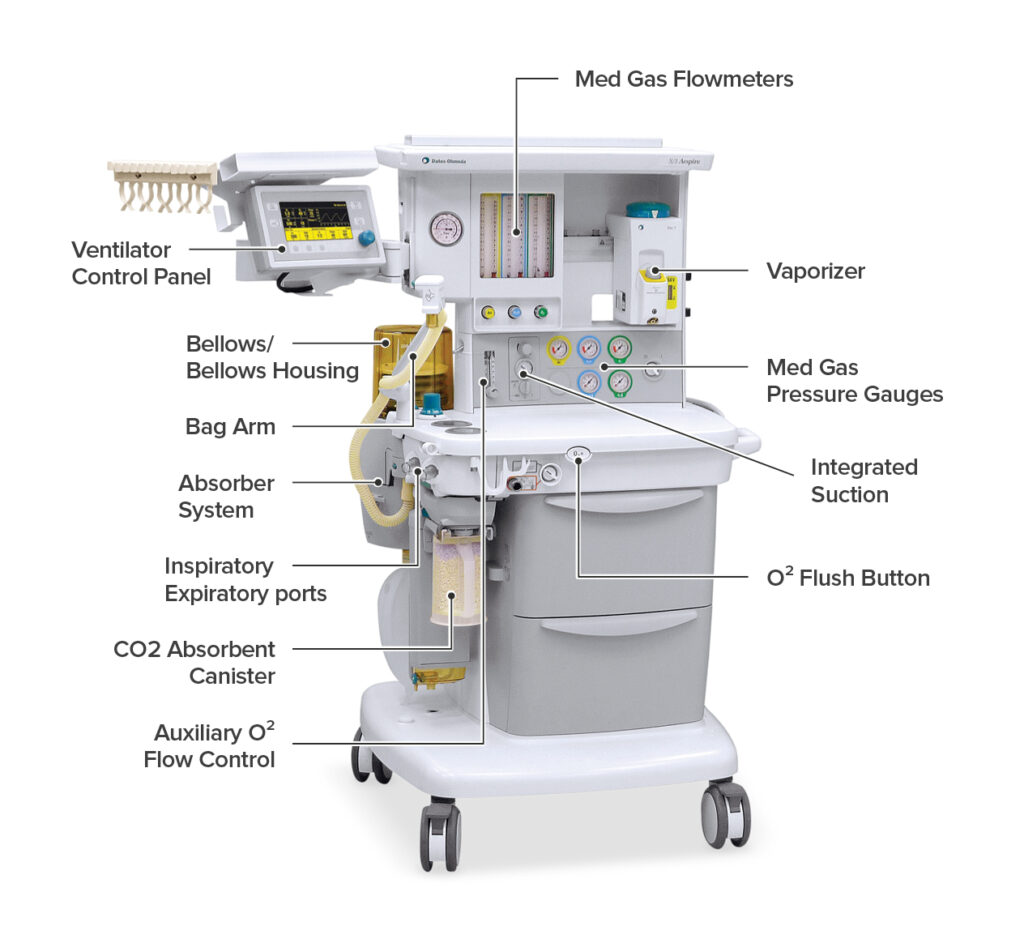
🔩 Key Components of an Anesthesia Machine — Explained
Pipeline inlets (O₂, N₂O, Air) + cylinder yokes + non-return valves. Color-coded per ISO standards.
Controls precise gas flow rates. Traditional rotameters or modern electronic flowmeters with digital display.
Converts liquid anesthetic to vapor. Calibrated for specific agents (isoflurane, sevoflurane, desflurane). Interlocks prevent simultaneous use.
Circle system with CO₂ absorber, APL valve, reservoir bag, and unidirectional valves. Delivers gas to patient and removes CO₂.
Manages patient breathing during general anesthesia. Piston or bellows-driven. Multiple ventilation modes.
Shows SpO₂, EtCO₂, airway pressure, tidal volume, respiratory rate, anesthetic concentration, and patient vitals.
Contains soda lime or Amsorb granules. Removes CO₂ from exhaled gases in rebreathing circuit. Requires regular replacement.
Oxygen failure alarm, high/low pressure alarms, apnea alarm, disconnect alarm. Mandatory pre-use checklist.
Rechargeable battery providing up to 60–90 minutes backup during power failure — critical for Nepal’s variable power supply.
📊 Types of Anesthesia Machines Available in Nepal (2026)
🔵 Basic Anesthesia Machine
Manual pneumatic controls, single vaporizer, basic ventilator, essential monitoring. Designed for straightforward surgical procedures in resource-limited settings.
- Price: NPR 3,00,000 – 5,50,000
- Best for: Small surgical clinics, minor OT, dental surgery centers
- Ventilation: Basic VCV mode, manual backup
- Monitoring: SpO₂, airway pressure, basic parameters
- Typical brands: Aeonmed, Comen, Penlon
🟡 Standard Anesthesia Workstation
Electronic flow control, integrated ventilator with multiple modes, digital touchscreen, dual vaporizer capacity, full patient monitoring integration. Suitable for general surgery and gynecological procedures.
- Price: NPR 7,00,000 – 15,00,000
- Best for: Private hospitals, district hospitals, general surgery OT
- Ventilation: VCV, PCV, SIMV, PSV modes
- Monitoring: Full multiparameter including EtCO₂
- Typical brands: Mindray A4/A5, BPL Premiair, Aeonmed 7900
🟢 Advanced Anesthesia Workstation
High-performance electronic gas mixing, advanced ventilation modes including lung-protective strategies, automated pre-use check, full ICU-level ventilation, digital record-keeping, EMR/HIS connectivity. The international standard for any serious OT.
- Price: NPR 20,00,000 – 35,00,000
- Best for: Tertiary hospitals, cardiac surgery, pediatric OT, medical colleges
- Ventilation: All modes + lung protective + low-flow anesthesia
- Monitoring: Integrated multiparameter + EtAgent + MAC tracking
- Typical brands: Mindray A7/A8/A9, GE Aespire/Avance CS2, Dräger Atlan/Fabius
🔴 Premium / Flagship Workstation
Highest-tier engineering with electronic vaporizers, automated end-tidal control (EtControl), ecoFLOW gas efficiency technology, automated anesthesia record-keeping (AARK), full EMR integration, and 15″+ touchscreen with customizable interface.
- Price: NPR 35,00,000 – 60,00,000+
- Best for: Academic medical centers, cardiac/neurosurgery centers, BPKIHS, TUTH, large private hospitals
- Typical brands: GE Aestiva, Dräger Perseus A500, Mindray A9, Getinge Flow-i
🧲 MRI-Compatible Anesthesia Machine
Specially designed for use within the MRI suite (up to 1.5T and 3T field strength). Non-ferromagnetic construction, long breathing circuit, remote monitoring. Required for any facility performing MRI-guided procedures under anesthesia.
- Price: NPR 40,00,000 – 80,00,000+
- Best for: Hospitals with MRI suites, neuroradiology centers
- Typical brands: Dräger Fabius MRI, GE Aestiva/5 MRI
🚑 Portable / Transport Anesthesia Machine
Compact, lightweight, battery-powered anesthesia delivery for field use, transport within the hospital, or procedures outside the main OT (e.g., endoscopy suites, radiology). Essential for hospitals with multiple procedure areas.
- Price: NPR 5,00,000 – 12,00,000
- Best for: Endoscopy suites, radiology, emergency procedures, field use
🔢 Basic vs Standard vs Advanced — Which Anesthesia Machine Should You Choose?
| Feature | Basic | Standard | Advanced ⭐ | Premium |
|---|---|---|---|---|
| Flow Control | Manual rotameters | Electronic + manual | Full electronic | Electronic + automated |
| Ventilation Modes | VCV basic | VCV, PCV, SIMV, PSV | All modes + lung-protective | All + EtControl + low-flow |
| Vaporizer | 1 mechanical vaporizer | 2 mechanical vaporizers | 2 mechanical or 1 electronic | Electronic vaporizer |
| Display | Analog gauges | 7–10″ color LCD | 12–15″ color touchscreen | 15″+ customizable |
| Monitoring | Basic SpO₂, pressure | SpO₂, EtCO₂, standard | Full multiparameter + EtAgent | Full + MAC tracking + AARK |
| Battery Backup | 30–45 min | 45–60 min | 60–90 min | 60–120 min |
| Pre-Use Check | Manual (checklist) | Semi-automated | Automated self-check | Fully automated |
| HIS/EMR Integration | None | Optional | Standard (Ethernet/WiFi) | Full AARK + EMR |
| Pediatric Capability | Limited | Moderate | Full (low tidal volume) | Full neonatal capability |
| Best For | Minor OT, clinics | General surgery OT | Hospital OT, cardiac, gynec | Academic, cardiac surgery |
| Price (NPR) | 3,00,000–5,50,000 | 7,00,000–15,00,000 | 20,00,000–35,00,000 | 35,00,000–60,00,000+ |
🎯 Nepali Prabidhi’s Recommendation
For any hospital OT performing general surgery, gynecology, orthopedics, or emergency cases — the Advanced Anesthesia Workstation is the right investment. The automated pre-use check, lung-protective ventilation modes, and full monitoring integration directly improve patient safety and reduce anesthesiologist workload. For facilities upgrading from older equipment, the efficiency and safety gains justify the investment within the first year of operation.
📞 Call 9820267438 for a free, facility-specific recommendation from our biomedical engineers.
🏨 Where Are Anesthesia Machines Used in Nepal?
Main Operation Theatre (मुख्य शल्यकक्ष)
The primary use — general, spinal, and regional anesthesia for all elective and emergency surgical procedures. The anesthesia machine is the central piece of equipment in any OT, around which the entire surgical workflow is organized. Nepal’s growing surgical volume — driven by rising rates of cesarean section, orthopedic trauma, abdominal surgery, and cancer surgery — is creating increasing demand for modern anesthesia workstations across all facility types. View our complete operation theatre equipment range.
Emergency & Trauma Surgery
Emergency surgery requires rapid setup and reliable performance under pressure. Road traffic accidents, obstetric emergencies, and abdominal emergencies are the leading causes of emergency surgical need in Nepal. Emergency OTs require machines with fast startup, reliable manual backup ventilation, and battery backup for power interruption scenarios — all features to verify with your supplier. Our emergency equipment range complements OT setup.
Obstetric & Maternity OT (प्रसूति शल्यकक्ष)
Cesarean section rates in Nepal are rising rapidly — a 40% increase across district hospitals was recorded in the MSS program since 2014. Every maternity hospital and obstetric unit performing C-sections requires a dedicated, well-maintained anesthesia machine. For obstetric use, spinal anesthesia is common, but a general anesthesia backup capability is mandatory for failed spinal or emergency GA conversions.
Pediatric Surgery
Pediatric anesthesia requires machines capable of very low tidal volumes (as low as 5–20ml) and precise flow control at low fresh gas flow rates. Standard adult machines are not adequate. Advanced workstations — particularly Mindray A8/A9 or equivalent — are required for neonatal and pediatric surgery, with special pediatric breathing circuits and low-compliance systems.
Cardiac Surgery
Cardiac anesthesia represents the highest-acuity anesthesia challenge — requiring full ICU-level ventilation capability, invasive hemodynamic monitoring, and the ability to manage patients during cardiopulmonary bypass. Only advanced or premium workstations are appropriate for cardiac surgery OTs in Nepal’s specialized centers.
Endoscopy & Procedure Suites
Procedures like ERCP, upper GI endoscopy, and bronchoscopy increasingly require monitored anesthesia care (MAC) or deep sedation. A compact transport anesthesia machine or a dedicated sedation workstation provides safe anesthesia delivery in non-OT procedure rooms.
District Hospitals & PHCCs
Nepal’s district-level hospitals, supported by the MSS program, are increasingly performing essential surgeries — primarily cesarean sections, wound care, appendectomies, and hernia repairs. A reliable standard anesthesia workstation is the minimum requirement for any district hospital aspiring to provide essential surgical care. Read about our complete hospital setup solutions.
🛡️ Essential Safety Features — What Every Anesthesia Machine Must Have
Patient safety is the absolute priority in anesthesia equipment. These safety features are non-negotiable — verify every one before purchasing any anesthesia machine for your facility.
| Safety Feature | Function | Consequence if Absent |
|---|---|---|
| Oxygen Failure Alarm | Alerts when O₂ pipeline/cylinder pressure falls below safe threshold | Patient receives hypoxic gas mixture — immediate risk of death |
| Anti-Hypoxia Device (Proportioning System) | Prevents delivery of gas mixtures with less than 21–25% oxygen | Anesthesiologist could inadvertently deliver 100% N₂O without O₂ |
| Vaporizer Interlock | Prevents simultaneous activation of two vaporizers | Overdose of anesthetic agent — life-threatening |
| Airway Pressure Alarms (High/Low) | Detects breathing circuit disconnection or obstruction | Patient apnea goes undetected — hypoxia and death risk |
| Apnea Alarm | Alerts if no breaths detected within set time period | Critical for detecting circuit disconnect or respiratory arrest |
| Capnography (EtCO₂) Monitor | Confirms correct endotracheal tube placement and adequate ventilation | Undetected esophageal intubation — fatal within minutes |
| Oxygen Analyzer | Continuously measures inspired oxygen concentration | Cannot detect hypoxic gas delivery from pipeline contamination |
| Battery Backup | Maintains operation during mains power failure | Machine shutdown during surgery — critical risk in Nepal’s power environment |
| Manual Ventilation Backup | Allows hand-bagging if ventilator fails | Patient cannot be ventilated during ventilator failure |
| Scavenging System | Removes waste anesthetic gases from OT | Chronic OT staff exposure — health risks for surgical team |
| Pressure Relief Valve | Prevents barotrauma from excessive airway pressure | Pulmonary barotrauma or pneumothorax in ventilated patients |
✅ Key Features Checklist — Before Buying an Anesthesia Machine in Nepal
| Specification | Minimum for Nepal | Premium Standard | Why It Matters |
|---|---|---|---|
| Ventilation Modes | VCV, PCV, manual | VCV, PCV, SIMV, PSV, lung-protective | Wider range handles complex cases |
| Tidal Volume Range | 50–1500 ml | 5–1500 ml (for neonates) | Pediatric & adult capability |
| Fresh Gas Flow Range | 0.2–10 L/min | 0.05–15 L/min | Low-flow anesthesia saves agent cost |
| Vaporizer Slots | 1 mechanical | 2 mechanical or 1 electronic | Flexibility with different agents |
| CO₂ Absorber Type | Soda lime canister | Amsorb or desiccated lime | Soda lime availability in Nepal |
| Display | 7″ color screen | 12–15″ color touchscreen | Usability and monitoring clarity |
| Battery Backup | 45 minutes minimum | 60–90 minutes | Essential for Nepal’s power supply |
| Cylinder Capacity | 1 O₂ + 1 N₂O cylinder | 2 O₂ + 2 N₂O cylinders | Backup for pipeline failure |
| Connectivity | USB export | Ethernet, WiFi, HIS/EMR integration | Digital record-keeping |
| Gas Compatibility | O₂, N₂O, Air | O₂, N₂O, Air + Heliox option | Handles specialty procedures |
| Safety Certifications | CE Mark, ISO 80601-2-13 | CE + ISO 80601-2-13 + IEC 60601-1 | Required for hospital accreditation |
| Voltage Range | 100–240V AC | 90–264V AC with surge protection | Critical for Nepal’s variable grid |
⚠️ Nepal-Specific Must-Check Factors
- Gas supply infrastructure: Does your facility have central medical gas pipelines (MGPS), or will the machine run entirely on cylinders? Many Nepal facilities still rely on cylinders. Ensure the machine is configured for cylinder use with proper yoke fittings and backup regulators.
- Soda lime availability: CO₂ absorber soda lime must be replaced regularly. Confirm that the granule type used by your machine (standard soda lime vs. Amsorb) is available in Nepal before purchasing. Nepali Prabidhi stocks OT consumables.
- Vaporizer agent availability: Isoflurane is the most widely available volatile anesthetic agent in Nepal. Sevoflurane is increasingly available. Desflurane is rare. Choose a machine with an isoflurane-compatible vaporizer as the primary, with sevoflurane as optional.
- Power backup: Load-shedding and voltage fluctuation are realities across Nepal. A machine with 60+ minute battery backup, wide voltage tolerance (90–264V), and built-in surge protection is essential.
- Service infrastructure: Verify your supplier has certified biomedical engineers in Nepal who can perform machine calibration, breathing circuit leak tests, vaporizer servicing, and emergency repairs locally.
🏆 Top Anesthesia Machine Brands Available in Nepal — Expert Analysis
Mindray — A-Series
Origin: China (Global Tier-1, Shenzhen)
Models: A4 (mid), A5 (standard), A7 (advanced), A8 (high-performance), A9 (flagship)
Strengths: Electronic vaporizers on A9, integrated HFNC on A8, ICU-level ventilation, intuitive touchscreen, excellent value for performance, strong regional support
Best for: Private hospitals, district hospitals, medical colleges, cardiac surgery (A8/A9)
Best Overall ValueGE Healthcare
Origin: USA (Chicago)
Models: Aespire View, Aestiva/5, Avance CS2, Aisys CS2
Strengths: SmartVent technology, ecoFLOW gas efficiency, 15″ touchscreen, seamless EMR integration, end-tidal control, industry-leading reliability
Best for: Tertiary hospitals, academic medical centers, cardiac surgery OTs
Best Flagship PerformanceDräger
Origin: Germany (Lübeck, est. 1889)
Models: Fabius GS Premium, Fabius Tiro, Fabius MRI, Atlan A350/A500, Perseus A500
Strengths: German engineering precision, E-Vent piston ventilator, tool-free circuit disassembly, Innovian digital anesthesia record system, legendary durability
Best for: Teaching hospitals, cardiac/neuro surgery, MRI-compatible needs
Best German EngineeringAeonmed
Origin: China (Beijing)
Models: Aeon7900A, Aeon8900, Aeon8700A
Strengths: Excellent value in mid-range segment, CE certified, wide Nepal market presence, reliable performance, competitive pricing, good local support
Best for: District hospitals, private mid-range hospitals, budget-conscious OTs
Best Budget Mid-RangeBPL Medical Technologies
Origin: India (Bengaluru)
Models: BPL Premiair series
Strengths: Indian manufacturing, competitive pricing for South Asia, strong service network, soda lime and consumables readily available in Nepal
Best for: Small hospitals, district-level OTs, government tender procurement
Best Value India-MadeGetinge / Maquet
Origin: Sweden
Models: Flow-i (premium), Flow-c (compact)
Strengths: Flow Core Technology for gas efficiency, MAC Brain clinical decision support, 15″ rotatable/tiltable touchscreen, height-adjustable ergonomic design, Hybrid OR compatibility
Best for: Premium private hospitals, hybrid ORs, advanced surgical centers
Best Scandinavian Design💰 Anesthesia Machine Price in Nepal — Complete 2026 Updated Price List
| Machine Type | Price Range (NPR) | Approx. USD | Typically Included | Ideal Setting |
|---|---|---|---|---|
| Basic Anesthesia Machine | NPR 3,00,000 – 5,50,000 | ~$2,200–$4,000 | Machine + 1 vaporizer + breathing circuit + basic warranty + installation | Minor surgery clinics, dental OT |
| Standard Anesthesia Workstation | NPR 7,00,000 – 15,00,000 | ~$5,100–$11,000 | Machine + 2 vaporizer slots + integrated ventilator + monitoring + accessories + 1-year warranty + free installation + training | Private hospitals, district hospitals |
| Advanced Anesthesia Workstation ⭐ | NPR 20,00,000 – 35,00,000 | ~$14,600–$25,600 | Machine + full accessory kit + advanced monitoring + all ventilation modes + WiFi/LAN + 1-year warranty + free installation + staff training + AMC option | Hospital OT, cardiac, gynecology, tertiary care |
| Premium / Flagship Workstation | NPR 35,00,000 – 60,00,000+ | ~$25,600–$44,000+ | Full workstation + electronic vaporizer + AARK + EMR integration + full support package | Academic medical centers, cardiac surgery, BPKIHS, TUTH |
| MRI-Compatible Machine | NPR 40,00,000 – 80,00,000+ | ~$29,000–$58,000+ | MRI-safe workstation + long circuit + remote monitoring + certification | Hospitals with MRI suites, neuroradiology |
| Portable / Transport Machine | NPR 5,00,000 – 12,00,000 | ~$3,700–$8,800 | Compact machine + cylinder mount + carry accessories + battery | Endoscopy, radiology, remote procedures |
Key Factors That Affect Anesthesia Machine Price in Nepal
- Brand origin: German (Dräger) and US (GE) brands command significant premium over Chinese brands; Indian brands (BPL) offer the most accessible pricing
- Ventilator sophistication: Piston ventilators (Dräger E-Vent) cost more than bellows-driven systems but offer superior performance
- Monitoring integration: Machines with built-in multiparameter monitors cost more but eliminate need for a separate monitor in the OT
- Electronic vs mechanical vaporizers: Electronic vaporizers (Mindray A9, GE Aisys) cost more but enable end-tidal control and automated dosing
- Battery capacity: Machines with 90+ minute backup cost more but are essential in Nepal’s power environment
- Import duties and logistics: Heavy equipment incurs higher freight costs, especially for non-Indian brands
📞 Get Your Custom Anesthesia Machine Quote
For accurate, current pricing with volume discounts, government tender pricing, and flexible payment arrangements:
📞 9820267438 | 📞 9851400020 | 💬 WhatsApp | 📋 Online Enquiry
📋 Step-by-Step Anesthesia Machine Buying Guide for Nepal
- Define Your Surgical Case Mix: What types of surgery does your facility perform — or plan to perform? General surgery and gynecology require standard to advanced machines. Cardiac and pediatric surgery require advanced or premium workstations. Emergency and obstetric OTs need reliable battery backup and manual ventilation backup as priority features.
- Assess Your Gas Supply Infrastructure: Does your facility have central medical gas pipeline system (MGPS) with O₂, N₂O, and air piped to the OT? Or will you rely on cylinders? Cylinder-dependent facilities need machines with 2-cylinder yokes per gas type and must plan for cylinder supply logistics. Facilities planning MGPS should verify the machine’s pipeline inlet compatibility before purchase.
- Determine Your Anesthetic Agent: Isoflurane is the standard volatile agent across most of Nepal. Sevoflurane is increasingly used in private hospitals. Confirm that vaporizers for your preferred agent are included and that the agent itself is available through reliable local suppliers before finalizing your machine choice.
- Set a Realistic Total Budget: Beyond the machine price, budget for: vaporizer(s) if not included, breathing circuit and CO₂ absorber consumables (NPR 3,000–8,000/month), gas cylinders or MGPS connection, installation and commissioning by a certified engineer, staff training, and AMC. Total cost of ownership over 5 years is the right metric.
- Check Pediatric Requirements: If your OT will handle pediatric patients (any age under 12), verify the machine can deliver tidal volumes as low as 20–50ml, has a pediatric breathing circuit option, and ideally includes a low-compliance breathing system. Not all basic or standard machines meet pediatric requirements.
- Verify EMR/HIS Integration Needs: If your hospital has or plans a Hospital Information System or anesthesia information management system (AIMS), verify the machine supports HL7/DICOM connectivity for automated anesthesia record transfer.
- Request On-Site Demonstration: This is essential for anesthesia machines — your anesthesia and nursing team must evaluate the interface, workflow, and pre-use check process on the actual machine before purchase. Schedule a free demo with Nepali Prabidhi.
- Verify Local Service Infrastructure: Who will perform machine servicing, vaporizer calibration, breathing circuit leak testing, and CO₂ absorber replacement? Confirm your supplier has biomedical engineers certified for anesthesia equipment in Nepal and carries spare parts locally. This is the most important factor for long-term safety.
🏗️ Complete OT Setup — What Else You Need
An anesthesia machine is the centerpiece of your operation theatre — but a complete, functional OT requires a full ecosystem of equipment. Nepali Prabidhi is your single-source partner for everything your OT needs:
LED shadowless lights (single and double dome) for optimal surgical field illumination
Hydraulic and electric OT tables with full positioning capability for all surgical positions
Full multiparameter monitors with SpO₂, EtCO₂, NIBP, ECG, temperature for OT use
Biphasic defibrillators for cardiac arrest response in the OT and recovery area
Precision drug delivery systems for propofol, heparin, vasopressors during surgery
Autoclaves, plasma sterilizers, and instrument sterilization systems for OT instruments
Complete surgical instrument sets for general surgery, gynecology, orthopedics, and specialty procedures
Complete end-to-end operation theatre design, equipment supply, installation, and commissioning
🔧 Anesthesia Machine Installation, Training & After-Sales Support
An anesthesia machine is the most complex and most critical piece of equipment in your OT. At Nepali Prabidhi, our post-sale support program is specifically designed to ensure every machine we supply operates safely and reliably throughout its clinical life.
Setup and commissioning by certified biomedical engineers. Includes OT site assessment, gas pipeline connection verification, electrical safety checks, and full machine commissioning.
Full pre-handover calibration of all vaporizers against reference standard. High-pressure and low-pressure leak testing of the breathing circuit. Written commissioning report for accreditation records.
Hands-on training for anesthesiologists, nurses, and OT technicians covering: pre-use checkout procedure, machine operation, ventilation modes, alarm response, CO₂ absorber change, vaporizer refilling, and circuit changes.
Scheduled preventive maintenance (twice yearly) including machine calibration, vaporizer service, breathing circuit inspection, alarm testing, and gas pathway leak check. Plus priority emergency response for breakdown support.
Breathing circuits, CO₂ absorber granules, APL valves, flow sensor replacement parts, vaporizer service kits — all stocked locally in our Kathmandu warehouse. No long international shipping delays.
Round-the-clock emergency telephone support for all AMC customers. On-site response within 24 hours in Kathmandu Valley, 48–72 hours in other provinces.
🇳🇵 Nepal-Specific Anesthesia Machine Considerations
Kathmandu Valley (Bagmati Province)
Kathmandu’s private hospitals and teaching hospitals — TUTH, BPKIHS (Dharan), Mediciti, Grande, Norvic, Vayodha — operate advanced and premium anesthesia workstations. New facilities entering Kathmandu’s competitive private hospital market should invest in at least advanced-tier workstations with full monitoring integration and HIS connectivity to meet patient and accreditation expectations. Nepali Prabidhi supplies multi-unit hospital setups with volume pricing.
Pokhara, Chitwan, Biratnagar, Butwal (Regional Hubs)
Nepal’s growing regional hospitals have emerged as important surgical hubs — Pokhara particularly for orthopedic and general surgery, Biratnagar and Birgunj for proximity to the Indian border population. Standard to advanced workstations are appropriate, with emphasis on battery backup for less reliable regional power supply.
District Hospitals (Zonal & District HQ)
The government’s MSS program has demonstrated that district hospitals can successfully increase surgical output when properly equipped. A standard anesthesia workstation — with robust battery backup, cylinder compatibility, and soda lime-based CO₂ absorption — represents the right investment at this level. Isoflurane vaporizer compatibility is essential as sevoflurane supply is unreliable in remote districts.
Maternity & PHCC Level Facilities
For PHCCs and maternity facilities primarily performing spinal anesthesia for C-sections, a basic to standard machine with reliable GA backup capability is appropriate. The machine must have manual ventilation backup and proven battery performance for emergency GA conversion when spinal anesthesia fails.
💚 Why Nepal’s Hospitals Trust Nepali Prabidhi for Anesthesia Machines
📍 Visit Our Showroom — Kalanki, Kathmandu
🌐 www.nepaliprabidhi.com |
📍 Kalanki, Kathmandu (Google Maps Directions)
🕐 Office Hours: Sunday–Friday 9:00 AM – 6:00 PM | Saturday 9:00 AM – 1:00 PM
🔗 Facebook | WhatsApp
🚀 Ready to Buy an Anesthesia Machine in Nepal?
Free consultation • Free demonstration • Competitive pricing • Certified installation • 24/7 OT support
📍 Kalanki, Kathmandu | Get Directions | 🌐 nepaliprabidhi.com | ✉️ [email protected]
❓ Frequently Asked Questions — Anesthesia Machine Price in Nepal (2026)
🏁 Conclusion — Safe Anesthesia Starts with the Right Machine
An anesthesia machine is not simply a piece of hospital equipment — it is the device that makes surgery possible, and on which every patient’s life depends during the procedure. Choosing the right machine, from a reputable brand, installed and maintained by certified engineers, is the single most important investment a surgical facility can make.
Nepal’s surgical care is expanding rapidly — driven by government investment, national insurance coverage, and growing patient expectations. Whether you are setting up a new operation theatre, upgrading aging equipment, or procuring for a government district hospital — Nepali Prabidhi delivers the right anesthesia machine, expertly installed, with the ongoing support your OT team needs.
Our promise: genuine products, competitive prices, free installation, certified engineer support, and a commitment to your facility’s surgical safety that extends far beyond the day of purchase.