RO Water Purifier for Hospital,
Clinic & Lab Setup in Nepal
Water purity is not optional in healthcare. This guide covers everything Nepal’s hospitals, clinics and labs need to know about selecting, installing and maintaining RO water purification systems.
Water is the most used substance in any hospital, clinic or laboratory. Yet it is also the most overlooked source of contamination. Nepal’s tap water and borewell sources often contain high TDS, coliform bacteria, heavy metals, chlorine residuals, and chemical pollutants.
For healthcare facilities, this is not just a quality issue. It is a patient safety issue. Therefore, treating your water supply is as important as any other clinical decision.
For example, if you are setting up a new diagnostic lab in Kathmandu, you need the right RO water purification system from day one. Similarly, upgrading a hospital ICU or launching a clinical laboratory in Pokhara or Chitwan requires a water system matched to your needs.
This guide by Nepali Prabidhi — Nepal’s trusted laboratory and medical equipment supplier — covers everything you need. In addition, you will find pricing, installation steps, maintenance schedules, and brand recommendations.
Why Pure Water Is Critical for Hospitals, Clinics & Labs in Nepal
Healthcare facilities in Nepal face a unique water quality challenge. Kathmandu’s municipal water (KUKL) typically has a TDS of 150–400 ppm. Seasonal spikes can push this even higher.
Furthermore, borewell water in the Terai can exceed 800 ppm TDS. It also contains significant iron and arsenic contamination. As a result, unfiltered water is entirely unsuitable for medical or laboratory use.
Diagnostic Accuracy
Impure water causes false test results in biochemistry, hematology and molecular diagnostics. Type II/III water is the minimum standard for diagnostic labs.
Infection Prevention
Contaminated water is a leading cause of hospital-acquired infections (HAIs). Purified water for instrument washing, sterilization and dialysis is mandatory.
Medication Preparation
IV fluids and injections prepared with impure water can introduce pyrogens, bacteria and chemical contaminants into patients.
Equipment Protection
High TDS water causes scale buildup in autoclaves, analyzers and sterilizers. This shortens lifespan and leads to costly breakdowns.
Dialysis Safety
Dialysis machines require water meeting AAMI/ISO standards. Key parameters include ultra-low endotoxins and bacteria below 0.1 CFU/mL.
Regulatory Compliance
Nepal’s DDA, ISO 15189, ISO 17025 and NABH standards all require documented water quality protocols for healthcare facilities.
Types of Purified Water for Hospitals & Labs in Nepal
Not all pure water is the same. International standards — ASTM D1193, ISO 3696 and CLSI — define three grades of laboratory and medical water. Each grade suits different applications.
Therefore, understanding these grades is the first step. It helps you choose the right water purification system for your facility in Nepal.
Ultrapure Water
Resistivity: 18.2 MΩ·cm
TOC: <5 ppb
Bacteria: <0.1 CFU/mL
Pure / Reagent Water
Resistivity: >1 MΩ·cm
TOC: <50 ppb
Bacteria: <10 CFU/mL
RO / Primary Grade Water
Resistivity: >0.05 MΩ·cm
TDS: <10 ppm
Bacteria: <1000 CFU/mL
Most diagnostic labs and clinics need Type II (RO + DI) water. Hospitals with dialysis units or molecular diagnostics need Type I (ultrapure). Basic health posts need minimum Type III (standard RO). Contact Nepali Prabidhi for a free, facility-specific recommendation.
RO Water Purifier for Hospitals in Nepal
Hospitals have the most demanding water purity requirements of any healthcare facility. A hospital-grade RO water purification system in Nepal must handle many applications at once. These include patient care, sterilization, lab work and dialysis.
Hospital Water Requirements — Application-Wise
| Application | Water Grade Required | Key Parameters | Risk if Unpurified |
|---|---|---|---|
| Dialysis / Hemodialysis | Ultra-High Purity | Chloramines <0.1 ppm, Bacteria <0.1 CFU/mL, Endotoxins <0.03 EU/mL | Hemolysis, pyrogenic reactions, patient death |
| Central Sterile Supply (CSSD) | Type III/Softened | TDS <100 ppm, No calcium/magnesium | Scale in autoclaves, inadequate sterilization |
| Pharmacy / IV Compounding | WFI Standard | Endotoxin-free, USP/EP purified water | Pyrogen introduction, patient harm |
| Laboratory (Clinical) | Type II (CLRW) | Resistivity >10 MΩ·cm, Bacteria <10 CFU/mL | False test results, equipment damage |
| Surgical Instrument Washing | Type III | TDS <200 ppm, No endotoxins | Instrument damage, infection risk |
| Dental Unit Water Lines | Potable + UV | Bacteria <500 CFU/mL (CDC standard) | Biofilm formation, patient infection |
| Drinking / Patient Use | WHO Drinking Standard | TDS <500 ppm, No coliforms | Waterborne disease, patient risk |
What System Do Hospitals in Nepal Need?
For most hospitals, the best solution is a centralized RO system with multiple distribution points. You should size it for your daily demand — typically 500 to 5,000 liters per day for a 50 to 200-bed hospital.
In addition, install a dedicated ultrapure branch for the laboratory and dialysis unit. This keeps sensitive applications separate from general hospital water. See our complete hospital setup services for more details.
RO Water Purifier for Clinics & Health Posts in Nepal
Clinics have simpler water purity needs than hospitals. However, those needs are still important. The minimum standard for any clinic in Nepal is an RO+UV system with TDS below 50 ppm for clinical water.
In addition, provide a separate drinking water outlet for staff and patients. This simple step protects both safety and compliance.
Small Clinic / Health Post
5–15 LPH wall-mount RO+UV+UF system. NPR 25,000–60,000. Covers drinking water, wound irrigation, and basic instrument rinse.
Dental Clinic
10–25 LPH RO+UV system with a direct line feed to dental unit water ports. NPR 40,000–1.2 lakh. Biofilm prevention is essential.
Polyclinic / Diagnostic Clinic
25–75 LPH RO+DI system. NPR 80,000–3 lakh. Supports on-site lab, pharmacy prep, IV fluid area and sterilization.
Pharmacy / Compounding
USP Purified Water system (RO+DI+UV). NPR 1.5–6 lakh. Mandatory for any facility preparing injectable solutions.
RO Water Purifier for Diagnostic & Research Labs in Nepal
The water purity requirement for labs in Nepal depends on the tests you perform. Using tap water or a domestic RO in a diagnostic lab is a very common mistake. It leads to inaccurate results, equipment damage, and failed accreditation audits.
Water Grade Required by Lab Test Type
| Lab Test / Equipment | Water Grade | Minimum Resistivity | System Needed |
|---|---|---|---|
| Hematology Analyzer (CBC) | Type III | 0.5 MΩ·cm | Basic RO |
| Semi-Auto Biochemistry | Type III | 1 MΩ·cm | RO+UV |
| Full-Auto Biochemistry | Type II/CLRW | 10 MΩ·cm | RO+DI+UV |
| Electrolyte Analyzer | Type II | 10 MΩ·cm | RO+DI |
| Immunoanalyzer / ELISA | Type II | 10 MΩ·cm | RO+DI+UV+0.22µm |
| Microbiology Media Prep | Type II | 10 MΩ·cm | RO+DI+UV |
| PCR / Molecular Biology | Type I | 18.2 MΩ·cm | Ultrapure System |
| HPLC / LC-MS | Type I | 18.2 MΩ·cm | Ultrapure + TOC <5 ppb |
| Cell Culture | Type I | 18.2 MΩ·cm | Ultrapure + Endotoxin-free |
| Autoclave / Glassware Wash | Type III | 0.05 MΩ·cm | Basic RO |
RO Water Purifier Price Guide for Hospital & Lab in Nepal (2026)
Below is a transparent pricing guide for medical and lab-grade RO water systems in Nepal. Prices reflect current market data and specifications.
| System Type | Capacity | Price (NPR) | Best For |
|---|---|---|---|
| Basic Clinical RO+UV (wall mount) | 10–25 LPH | NPR 25,000–60,000 | Small clinics, health posts, dental |
| RO+UV+UF (floor standing) | 25–75 LPH | NPR 55,000–1.5 lakh | Polyclinics, diagnostic centers |
| RO+DI+UV (lab grade Type II) | 30–100 LPH | NPR 80,000–3 lakh | Diagnostic labs, semi-auto analyzers |
| Industrial RO System (centralized) | 200–2000 LPH | NPR 2–15 lakh | Hospitals, nursing homes, dialysis centers |
| Ultrapure Type I System (benchtop) | 3–15 LPH | NPR 3–12 lakh | PCR labs, HPLC, molecular diagnostics |
| Dialysis Water Treatment System | 500–2000 LPH | NPR 8–25 lakh | Hemodialysis units, hospitals |
| Complete Water Purification Plant | Custom | NPR 15 lakh+ | Large hospitals, medical colleges |
How to Choose the Right RO Water Purifier for Your Facility in Nepal
Selecting the right system starts with five key questions. Answer each one carefully before you purchase anything.
RO Water Purifier Installation for Hospitals & Labs in Nepal
Proper installation is critical. A poorly installed RO system will underperform and contaminate water downstream. Therefore, always use a qualified service team.
Here is what a professional installation by Nepali Prabidhi’s service team includes:
- Site inspection — assess water source, inlet pressure, available space, electrical supply, and drain access
- Pre-treatment installation — sediment pre-filter (5μm), carbon block filter for chlorine removal, optional softener for hard water areas
- Main RO unit installation — mounting, pressure gauge fitting, TDS meter probe, automatic shut-off valve
- Post-treatment connection — DI cartridge, UV lamp, ultrafiltration membrane (for Type I systems)
- Storage tank and distribution — pressurized or atmospheric storage, distribution pump, point-of-use outlets
- Commissioning and QC — TDS reading verification, flow rate measurement, leak testing, bacteriological water quality check
- Staff training — operating procedure, filter change schedule, warning signs, documentation for ISO/accreditation
Nepal’s water supply is often intermittent. As a result, all hospital and lab RO systems need a feed water booster pump. Inlet pressure is frequently below 1 kg/cm². In addition, install a raw water storage tank (500L–2,000L) before the RO unit. Finally, add a voltage stabilizer to protect the system from power fluctuations. These three additions are not optional in Nepal — they are essential.
Maintenance Schedule for Hospital & Lab RO Systems in Nepal
Regular maintenance keeps your RO system performing at the required purity level. Neglecting maintenance is the most common reason RO systems fail in Nepal. Use the schedule below as your standard reference.
| Component | Service Frequency | Action | Importance |
|---|---|---|---|
| Sediment Pre-filter (5μm) | Every 2–3 months | Replace cartridge | Critical |
| Carbon Block Filter | Every 3–6 months | Replace cartridge | Critical |
| RO Membrane | Every 12–24 months | Replace membrane | Critical |
| DI Resin Cartridge (Type II) | Every 6–12 months or when resistivity drops | Replace or regenerate | Critical |
| UV Lamp | Every 12 months | Replace regardless of visible light | High |
| Post-carbon Polishing Filter | Every 6–12 months | Replace cartridge | High |
| Storage Tank Sanitization | Every 3 months | Chemical or UV sanitization | High |
| TDS / Conductivity Monitoring | Daily (lab); Weekly (clinic) | Log and compare to baseline | Routine |
| Bacteriological Water Quality Test | Monthly (ISO labs); Quarterly (clinics) | Plate count, coliform test | High |
| Full System Service (AMC) | Annually | Complete inspection and all replacements | Critical |
Nepali Prabidhi offers Annual Maintenance Contracts (AMC) for all water purification systems we supply. Moreover, our AMC covers scheduled filter replacements, TDS monitoring, bacteriological testing, and emergency call-out within 24 hours. Enquire about our AMC plans here.
Recommended RO Water Purifier Brands for Hospital & Lab Use in Nepal
Not all RO brands suit healthcare use. Specifically, you need brands built to clinical and laboratory standards. Nepali Prabidhi recommends and supplies the following medical and lab-grade water purification brands in Nepal:
Milli-Q (Merck / MilliporeSigma)
World’s most trusted lab water system. Produces Type I ultrapure water at 18.2 MΩ·cm. Ideal for PCR labs, HPLC and molecular diagnostics.
ELGA LabWater (Veolia)
PURELAB series covers Type I, II and III water. Used in pharmaceutical and clinical labs globally. Compliant with ISO 3696 and ASTM D1193.
Thermo Fisher Barnstead
Smart2Pure and Pacific RO series. Meets ASTM Type I and II standards. Ideal for diagnostic labs and hospital pharmacy departments.
Industrial RO Systems (Nepal-assembled)
Custom-built centralized RO plants for hospitals. Available from 500 to 5,000 LPH. Configured for Nepal’s water conditions and intermittent supply.
For a full list of available systems and current pricing in Nepal, contact Nepali Prabidhi or call 9820267438.
Need a Water Purifier for Your Hospital, Clinic or Lab in Nepal?
Get a free site assessment, water quality test and transparent system quotation from Nepal’s trusted medical equipment supplier.
Frequently Asked Questions — RO Water Purifier for Hospital, Clinic & Lab in Nepal
Below are common questions about medical and lab-grade RO water purification systems in Nepal. Click any question to expand the answer.
Nepal’s water — from KUKL lines, borewells, or tankers — often contains high TDS (150–800 ppm), coliform bacteria, arsenic, iron, chlorine, and other pollutants. For healthcare facilities, this causes false diagnostic results, hospital-acquired infections, instrument damage, and regulatory non-compliance.
Therefore, an RO water purification system is not a luxury. It is a mandatory part of safe healthcare infrastructure in Nepal.
Most diagnostic labs in Nepal need at least Type II water (RO + DI + UV). This grade supports biochemistry analyzers, electrolyte analyzers, immunoanalyzers and reagent preparation.
However, labs performing PCR, HPLC or cell culture require Type I ultrapure water (18.2 MΩ·cm). Basic labs running only CBC and urinalysis can use Type III (standard lab RO). Contact Nepali Prabidhi for a free recommendation.
Prices vary by system type. Basic clinical RO systems for small clinics cost NPR 25,000–60,000. Lab-grade RO+DI systems for diagnostic centers cost NPR 80,000–3 lakh.
Centralized industrial RO plants for hospitals cost NPR 2–15 lakh. Dialysis-grade water treatment systems cost NPR 8–25 lakh. Call 9820267438 or submit an enquiry for a site-specific quotation.
No — we strongly advise against this. Domestic RO purifiers (Kent, Aquafresh, Faber, Forbes, etc.) target drinking water at 5–25 LPH. They do not remove ionic contaminants to clinical standards and lack DI polishing.
As a result, using a domestic RO in a clinical lab will cause analyzer contamination, reagent failure, and inaccurate test results. It can also lead to ISO 15189 accreditation failure. Always specify clinical or laboratory-grade RO systems for any healthcare application.
In Nepal, sediment loads are high and water quality varies seasonally. Therefore, we recommend changing sediment pre-filters every 2–3 months and carbon block filters every 3–6 months.
RO membranes should be replaced every 12–24 months. UV lamps need annual replacement. DI cartridges should be changed when resistivity drops below specification. In addition, all ISO 15189 and ISO 17025 facilities must carry out daily TDS monitoring and monthly bacteriological water quality testing.
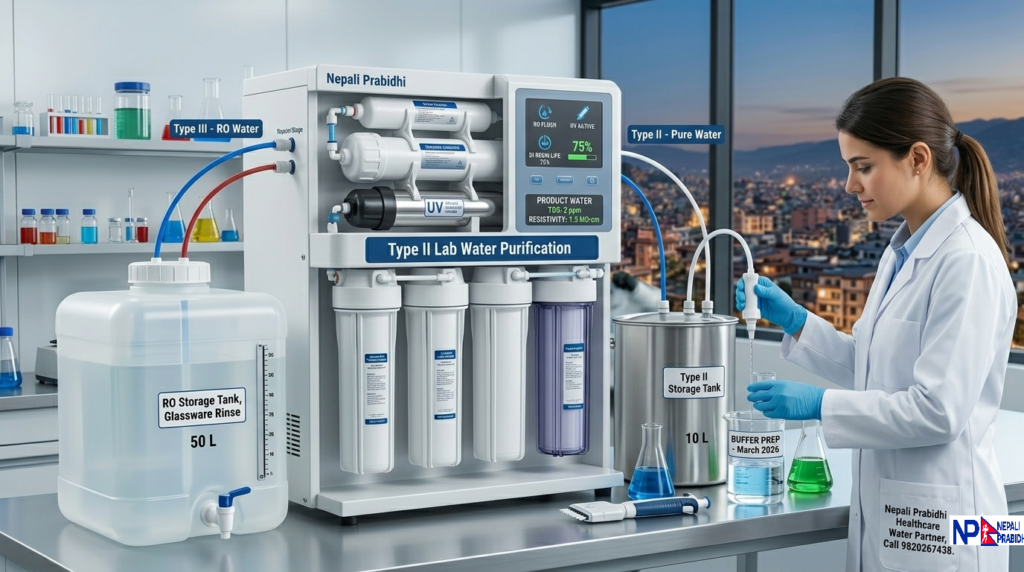
Type III (RO water) comes from reverse osmosis alone. It suits glassware rinsing, autoclave fill and heating baths. Type II (pure water) uses RO + DI + UV. It supports buffer preparation, culture media and general biochemistry.
Type I (ultrapure water) adds ion exchange polishing to reach 18.2 MΩ·cm resistivity. This grade is essential for HPLC, PCR, mass spectrometry and cell culture. Most diagnostic labs in Nepal need Type II as a minimum. Research and molecular labs need Type I.
Yes. Nepali Prabidhi supplies and installs RO water purification systems across all of Nepal. We serve Pokhara, Chitwan, Birgunj, Biratnagar, Butwal, Nepalgunj, Dhangadhi, and all other districts.
We offer same-day delivery within the Kathmandu Valley, 24-hour delivery to Pokhara, Chitwan and Birgunj, and 48-hour delivery nationwide. Contact us at 9820267438 or info@nepaliprabidhi.com.
Conclusion: Invest in the Right Water Purification System
Pure water is not a feature — it is a foundation. Every diagnostic test, sterilization cycle and medication prepared in your facility depends on water quality. Choosing the wrong system puts patients, results and accreditation at risk.
Furthermore, using a domestic purifier in a clinical setting is not acceptable. It exposes your facility to liability, equipment failure and test errors. Therefore, always specify a clinical or lab-grade system.
Nepali Prabidhi has installed water purification systems in 200+ healthcare facilities across Nepal. We supply, install, commission and maintain everything — from a basic clinic RO to a hospital-wide centralized system or a Type I ultrapure system for your PCR lab.
📱 9820267438 / 9851400020
✉️ info@nepaliprabidhi.com
💬 WhatsApp Chat
📍 Kalanki, Kathmandu, Nepal
Related Guides from Nepali Prabidhi
Quick Reference — Contact & Navigation
| 📱 | Call / WhatsApp9820267438 |
| 📱 | Alternate Line9851400020 |
| ✉️ | Emailinfo@nepaliprabidhi.com |
| 💬 | WhatsApp ChatChat with us on WhatsApp |
| 📋 | Free Online Enquiry FormSubmit Enquiry at nepaliprabidhi.com/enquiry-now |
| 🌐 | Websitewww.nepaliprabidhi.com |
| 📍 | Our LocationKalanki, Kathmandu, Nepal |