Medical Equipment Maintenance in Nepal — The Complete Guide Every Hospital, Clinic & Lab Needs Right Now
Practical, honest, Nepal-specific. If you manage a hospital, run a diagnostic lab, operate a clinic, or oversee a health post — this guide was written for you. Find out what is going wrong across Nepal’s healthcare facilities, why it matters more than you think, and exactly what to do about it.
“The ventilator gave an error code at 3 AM. We had a critical patient. Our only option was to transfer them — and we lost precious time. The machine had been giving small warnings for weeks. Nobody acted on it.”
That is a real account from a hospital manager in Kathmandu. He shared it not to place blame, but because he wanted other facilities to hear it before they experience the same thing.
Nepal’s healthcare sector is growing fast. New hospitals, diagnostic centers, and specialist clinics are opening across the country. Doctors are better trained. Equipment is more advanced. But there is one area where most facilities — large and small — are still dangerously behind: medical equipment maintenance in Nepal.
A nationwide research survey found that over 60% of medical devices in Nepal’s hospitals were either non-functional or giving unreliable results — not because the machines were too old, but because nobody had a system to maintain them. That statistic should alarm every healthcare facility owner and manager in the country.
This guide is practical, direct, and written from real experience. By the time you finish reading it, you will understand exactly what is at stake — and what steps to take.
Why Nepal’s Healthcare Facilities Are Struggling with Equipment
Let us be honest about the situation on the ground. Most hospital directors and lab managers are doing their best with limited resources. The challenges they face with equipment management are real, and they are widespread — from Kathmandu to Pokhara, from Chitwan to Biratnagar, and across districts throughout Nepal.
When a machine breaks, most facilities spend days — sometimes weeks — trying to find someone qualified to fix it. The shortage of trained biomedical engineers in Nepal is one of the most underreported problems in the sector.
Many hospitals import equipment from India, China, or Europe. When a part fails, it often cannot be found locally. The machine sits idle for weeks while patients are referred elsewhere and revenue is lost.
Nepal’s power supply — with its voltage spikes and irregular current — is one of the leading hidden causes of equipment failure. Sensitive analyzers and monitors suffer circuit damage that nobody notices until the machine stops working entirely.
Most facilities have never maintained a service log for their equipment. Without records, faults go undetected, calibration drift goes unchecked, and government inspectors find nothing to verify — creating serious compliance risk.
What Proper Medical Equipment Maintenance Actually Does for Your Facility
People sometimes talk about equipment maintenance as if it is just about keeping machines running. It is much more than that. Here is what regular, professional hospital equipment service in Nepal actually delivers:
It Protects Your Patients — Directly
Think about a biochemistry analyzer that has not been calibrated in 18 months. It is still running. It is still producing results. But those results may be off by 15–20%. A doctor reading a creatinine level of 0.9 when the real value is 1.3 makes a different treatment decision. That is not a hypothetical risk — it is happening in Nepal right now, in facilities where lab equipment maintenance in Nepal is being skipped.
“A machine that appears to be working is not the same as a machine that is working correctly. Calibration drift is silent — but its consequences are not.”
Nepali Prabidhi Biomedical TeamIt Saves Far More Money Than It Costs
This is the point that surprises most facility managers the first time they see the numbers clearly laid out:
A planned PM visit costs a fraction of an emergency repair for the same fault found weeks later.
Well-maintained equipment routinely lasts 10+ years. Neglected machines often fail at 4–5 years — wasting crores in capital.
Nepal’s MoHP now requires service records. Facilities with proper maintenance pass inspections without stress.
- Machines break without warning
- Emergency repairs cost 3–5× more
- Diagnostic results may be inaccurate
- Equipment lasts 4–5 years
- Fail government inspection
- Patients transferred, revenue lost
- No service records to show
- Problems caught early, fixed cheaply
- One predictable annual AMC cost
- Calibrated equipment = accurate results
- Equipment lasts 10–12+ years
- Full compliance records in place
- Patients stay, facility reputation grows
- Inspection-ready at any time
7 Equipment Problems We See in Nepal’s Healthcare Facilities Every Single Week
These are not theoretical problems. These are the service calls our engineers respond to across Nepal on a weekly basis. If you recognize any of them, it is time to act before they become emergencies:
- Ventilators showing alarm codes or failing mid-procedure — usually caused by dirty internal sensors, expired filters, or firmware that was never updated after purchase. A 30-minute PM visit would have caught all of it.
- Biochemistry analyzers giving inconsistent readings — calibration drift is the most common culprit, especially in labs that rely on the same machine for dozens of tests daily without quarterly QC validation.
- Digital X-ray systems producing low-quality images — detector panels and HV generators degrade gradually. Without periodic calibration checks, nobody notices until a radiologist flags a blurry report.
- Autoclaves failing sterilization cycles — pressure and temperature sensors in autoclaves require regular verification. A failed sterilization that goes undetected is one of the most serious patient safety risks in any facility.
- Centrifuges overheating or vibrating abnormally — early signs of motor brush and bearing wear. Left unserviced, the rotor eventually fails — sometimes mid-spin, which is a safety hazard for staff.
- Infusion pumps delivering inaccurate flow rates — even small calibration errors in pumps administering critical IV medications can have serious patient consequences. These are serviced far too rarely in Nepal.
- Patient monitors reading incorrectly after power surges — Nepal’s power fluctuations reset internal calibration in monitors. A post-surge check should be standard after any major power event.
The Solutions That Actually Work for Nepal’s Healthcare Facilities
Nepal now has professional, structured solutions for every size of healthcare facility. Whether you manage a large multi-specialty hospital or a single-room health post, there is a maintenance model that fits. Here is what a complete hospital equipment service Nepal program looks like:
A Complete Biomedical Maintenance & Setup Solution
Everything under one trusted partner — no need to call five different vendors
The most important decision is simply choosing the right approach. A proactive facility that plans its maintenance spends far less over five years than a reactive one that only calls for help when something is already broken.
How Nepali Prabidhi Helps Healthcare Facilities Across Nepal
Nepali Prabidhi was built specifically for Nepal’s healthcare environment — by engineers who understand local conditions, local equipment brands, and the real-world challenges facilities face here. The company has supported 200+ hospitals, labs, and healthcare facilities across Nepal, from major Kathmandu institutions to clinics and health posts in provincial districts.
What makes Nepali Prabidhi different from a typical equipment vendor? Simple: the relationship does not end after the machine is delivered. Every facility that works with Nepali Prabidhi gets a long-term technical partner — one that knows your equipment, tracks your service history, and responds when you need help.
What Your Facility Gets
- Local certified biomedical engineers, based in Nepal — no waiting for a technician from India or China. When you call, someone who knows Nepal’s healthcare reality comes to you
- 50+ globally certified equipment brands — Mindray, Sysmex, Horiba, Olympus, BPL, Remi, Esco, Bio-Rad, Roche, and many more. Supply with full warranty and after-sales support
- Transparent AMC pricing, no hidden charges — one clear annual fee based on your specific equipment. Most facilities save 40–60% on total equipment costs compared to emergency-only repair
- Complete hospital, ICU & OT setup service — from first consultation to final handover. Staff trained on every piece of equipment before we leave
- Lab setup with full NPHL registration support — basic clinic labs from NPR 10–15 lakh up to Category A reference labs
- Power protection solutions designed for Nepal — voltage stabilizers and UPS systems that protect sensitive equipment from Nepal’s grid realities
- 24/7 emergency helpline — existing clients can call anytime. A real person answers, not a recorded message
Sun–Fri 9–6 · Sat 9–1 · Emergency 24/7
Final Thoughts — Stop Waiting for Something to Break
Nepal’s healthcare facilities are at an important crossroads. The equipment is better than ever. The patient expectations are higher than ever. And now, the government’s new biomedical maintenance standard makes this official: you cannot run a healthcare facility without a proper equipment maintenance system.
But beyond compliance, beyond cost savings, beyond inspection scores — there is a simpler reason to take this seriously. Your patients trust you with their health. They deserve machines that work correctly. They deserve lab results that are accurate. They deserve a ventilator that does not give an error code at 3 AM.
Regular, professional medical equipment maintenance in Nepal is how you honour that trust — and how you protect your facility at the same time.
You do not need to figure this out alone. Nepali Prabidhi has done this for 200+ facilities across Nepal. The team, the engineers, and the experience are there. The only question is whether you reach out before or after something breaks.
Is Your Equipment Ready to Serve Your Patients Today?
Get a free biomedical equipment audit — no cost, no obligation. Our engineers will assess your equipment and give you an honest, itemized picture of what needs attention. Available for facilities across Nepal.
Frequently Asked Questions
Have a question? Click any question below to read the answer. The most important ones are shown first.
This is the question we get asked most often — usually after a facility has already had a bad experience with a machine failure.
Regular medical equipment maintenance in Nepal does four things at once: it prevents machines from breaking down unexpectedly during patient care; it ensures diagnostic results are accurate because equipment is properly calibrated; it extends machine lifespan significantly (often doubling it from 5 years to 10+); and it keeps your facility compliant with Nepal’s new MoHP Biomedical Equipment Standard 2082.
The bottom line is this: every rupee you spend on planned maintenance saves 3–5 rupees in emergency repair costs later. And beyond money, it protects your patients and your reputation.
An AMC — Annual Maintenance Contract — is a yearly service agreement between your healthcare facility and a biomedical service provider like Nepali Prabidhi.
For one fixed annual fee, you receive:
- Scheduled preventive maintenance visits (typically quarterly)
- Priority emergency repair call-outs when equipment fails
- Full calibration of all covered equipment with certificates
- Complete service history records for every machine
- Minor replacement parts included in the agreement
The biggest benefit is financial predictability. Instead of receiving a surprise NPR 2–3 lakh repair bill, your facility has one known annual cost — and everything is covered. Most facilities that switch to an AMC model report saving 40–60% on total annual equipment costs.
👉 Call 9820267438 or email info@nepaliprabidhi.com for a free AMC quotation for your facility.
AMC pricing depends on three factors: the number of machines in your facility, the types of equipment (ICU equipment AMCs cost more than basic analyzers), and whether you want a comprehensive or basic coverage package.
There is no single fixed price — and we would be doing you a disservice if we quoted a generic number here. What we do offer is a free, itemized, transparent AMC quotation for your specific facility and equipment list. No hidden charges, no vague estimates.
What we can tell you from experience: even a basic AMC for a small to mid-size facility almost always costs less than one emergency repair call-out per year. The math almost always favours the AMC.
To get your free quote: call 9820267438, call 9851400020, or email info@nepaliprabidhi.com. Nepali Prabidhi serves facilities across Nepal.
Yes. Nepali Prabidhi provides hospital equipment service Nepal-wide — not just within Kathmandu Valley. Our engineers travel to facilities across the country.
Our typical response times are:
- Kathmandu Valley — same-day response for both AMC clients and new service calls
- Pokhara and Chitwan — within 24 hours
- Biratnagar, Butwal, Dharan, Nepalgunj, Birgunj, and other cities — within 48 hours
AMC clients across Nepal receive priority scheduling and discounted emergency call-out rates. If your facility is in a more remote location, we can arrange a service visit schedule as part of your AMC agreement.
Yes — completely. This is one of our most requested services across Nepal.
Our hospital setup Nepal service is fully turnkey, covering every stage:
- Equipment needs assessment and floor plan review
- Brand selection from 50+ globally certified manufacturers
- Procurement, import, customs clearance
- Transportation and delivery anywhere in Nepal
- Professional installation and commissioning
- Full staff training on every piece of equipment
For ICU setup Nepal, we provide ventilators, multi-parameter monitors, infusion and syringe pumps, defibrillators, suction machines, central oxygen pipeline systems, ICU beds, and nurse call systems.
For lab setup Nepal, our packages range from basic clinic labs (NPR 10–15 lakh) to full NPHL Category A reference labs (NPR 80 lakh to 2+ crore). We include LIS software and full NPHL registration support.
Call 9820267438 to start your project discussion. We work with hospital owners, promoters, and facility developers at every stage.
Nepali Prabidhi provides medical equipment maintenance Nepal-wide for a comprehensive range of hospital and laboratory equipment, including:
- Ventilators and ICU life support systems — critical care PM and emergency repair
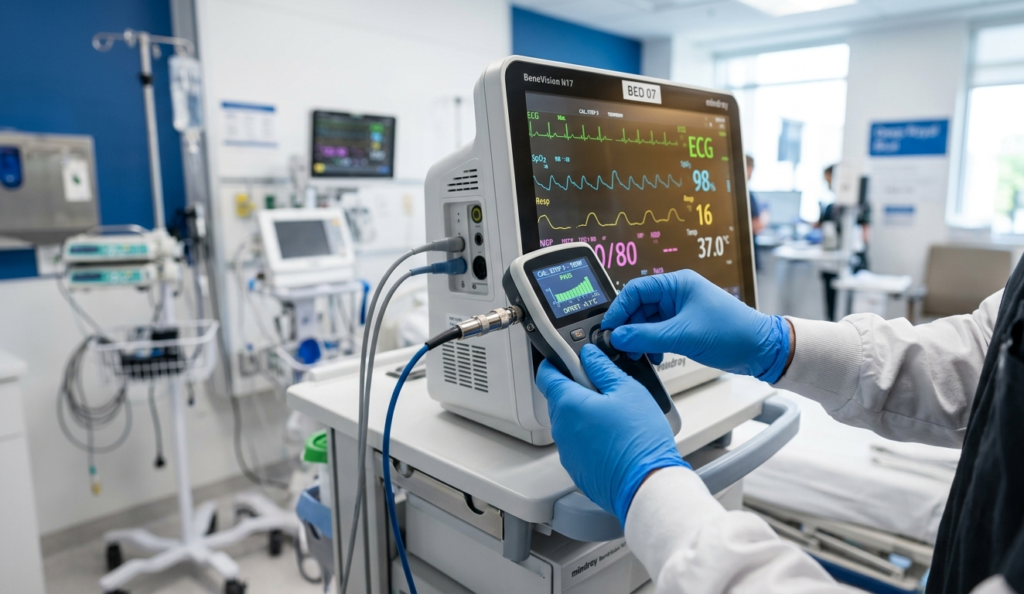
- Multi-parameter patient monitors — SpO₂, NIBP, ECG, EtCO₂ calibration
- Digital X-ray systems (DR/CR) — full calibration and service
- Ultrasound machines — probe testing, software updates, system service
- Biochemistry analyzers (Mindray, BPL, Erba) — lab equipment maintenance Nepal, QC alignment
- Hematology analyzers (Sysmex, Horiba, Mindray) — full service and AMC
- Autoclaves and sterilization equipment — safety-critical validation
- Centrifuges, microscopes, incubators, biosafety cabinets
- Infusion and syringe pumps — accuracy calibration
- ECG machines and defibrillators
- Dialysis machines — nephrology department support
- OT equipment — surgical lights, OT tables, anesthesia machines
- Dental X-ray units and dental chairs
For a full equipment list and service capabilities, visit nepaliprabidhi.com/services →
Nepali Prabidhi is an authorized dealer and service partner for 50+ internationally certified brands. Here is a summary by category:
- Hematology analyzers — Mindray, Sysmex, Horiba, Nihon Kohden
- Biochemistry analyzers — Mindray, BPL, Erba, Transasia
- Immunoassay systems — Mindray, Snibe, Autobio
- Microscopes — Olympus, Nikon, Labomed, Motic
- Centrifuges — Remi, BPL, Hermle, ELMI
- Biosafety cabinets & laminar flow — Esco, Biobase, Thermo Fisher
- PCR & molecular systems — Bio-Rad, Applied Biosystems, Roche, Qiagen
- Patient monitoring — Mindray, BPL, Schiller
- Ventilators — Mindray, Hamilton, Dräger (select models)
All equipment is supplied with manufacturer warranty, professional installation, and full after-sales service support. Call 9820267438 for current availability and pricing.
Nepal’s Ministry of Health and Population, in collaboration with WHO Nepal and UNITAID, published the National Biomedical Equipment Maintenance Standard 2082 in December 2025. This 13-chapter framework is now applicable to all healthcare facilities registered under Nepal’s health services regulations.
Key requirements that directly affect your facility include:
- Maintaining an updated equipment inventory/profile for all medical devices
- Implementing a risk-based maintenance categorization system
- Conducting and documenting scheduled calibration for diagnostic equipment
- Maintaining service logs and maintenance records accessible during inspections
- Having an AMC or equivalent formal maintenance agreement in place for critical equipment
- Training designated staff on basic equipment handling and reporting protocols
Facilities that cannot demonstrate compliance during MoHP or NHRC inspections face risk of operating license conditions or suspension. Nepali Prabidhi can help your facility become fully compliant — including maintaining all required documentation as part of an AMC agreement.
Yes. Nepali Prabidhi provides comprehensive support for labs seeking NPHL (National Public Health Laboratory) registration in Nepal.
Our NPHL support includes:
- Providing the correct equipment list for your NPHL category (A, B, or C)
- Advising on lab layout requirements for NPHL compliance
- Preparing documentation packages for the application process
- Helping draft Standard Operating Procedures (SOPs)
- Pre-inspection equipment checks and calibration to ensure readiness
- Ongoing lab equipment maintenance to maintain NPHL certification year after year
Read our detailed guide: Pathology Lab Equipment List Nepal → or call 9851201925 to speak with our lab setup specialist.
This is one of the most overlooked causes of equipment failure across Nepal’s healthcare facilities. Nepal’s power grid — despite improvements — still experiences voltage surges, frequency variations, and sudden cutoffs that are harmful to sensitive electronic medical equipment.
The specific risks include:
- Biochemistry and hematology analyzers — power surges can damage motherboards and lamp units, causing expensive circuit-level failures
- Patient monitors and ICU equipment — unclean power resets internal calibration and stresses power supply units over time
- Digital X-ray generators — voltage instability accelerates HV component degradation
- Refrigerators and incubators — temperature fluctuations during power cuts compromise stored reagents and samples
The prevention is straightforward: every piece of sensitive medical equipment should be connected to an appropriate voltage stabilizer and UPS system. Nepali Prabidhi assesses power protection requirements for every facility and recommends the right specifications. This is included as standard in all of our new hospital and lab setup projects.
Great question — these two terms are related but different, and understanding the distinction helps you choose the right service level for your facility.
Preventive Maintenance (PM) refers to a single scheduled service visit where our engineers inspect, clean, calibrate, and check your equipment. You can book one PM visit at any time, for any machine.
Annual Maintenance Contract (AMC) is a comprehensive yearly agreement that includes:
- Multiple PM visits throughout the year (typically quarterly)
- Priority emergency response included (no extra call-out fee)
- Calibration certificates and full service documentation
- Minor parts and consumables included up to an agreed threshold
- One predictable annual cost — no surprise invoices
For most facilities, an AMC is the better choice because it provides full financial predictability and priority service. For smaller facilities or single pieces of equipment, individual PM visits may be more appropriate. Nepali Prabidhi can advise on the best fit during a free consultation.
Booking is simple. You have four options:
- Call directly — 9820267438 (primary/emergency), 9851400020 (sales/AMC), or 9851201925 (lab specialist)
- WhatsApp — send a message to 9779820267438 describing your requirement and location
- Email — write to info@nepaliprabidhi.com with your facility name, location, and equipment list
- Visit us — our office is at Kalanki, Kathmandu. Walk-ins are welcome during office hours: Sun–Fri 9AM–6PM, Sat 9AM–1PM
For emergency breakdowns, our 24/7 helpline (9820267438) is monitored by our on-call engineer team. AMC clients receive priority dispatch.