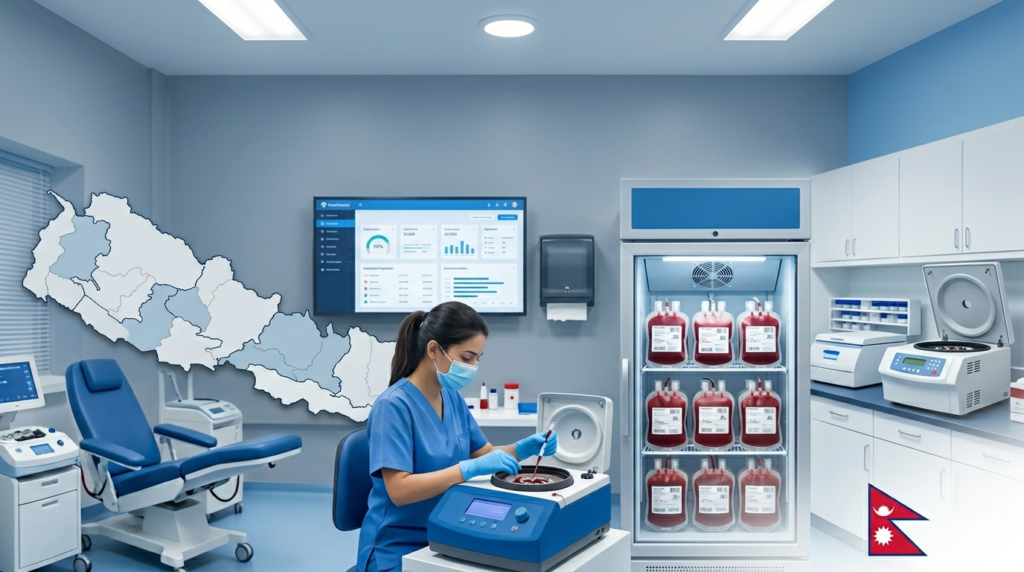
Blood Bank Setup in Nepal: The Complete Guide for Every Hospital & Province
From Kathmandu’s busiest hospitals to Nepal’s most remote districts — everything you need to know about setting up a blood bank in Nepal in 2026.
Why Blood Banks Are a Critical Need Across All of Nepal
Nepal’s healthcare sector is growing rapidly. New hospitals are opening across all seven provinces. Medical colleges need accredited blood banks. District hospitals are expanding. And every single one of them has one urgent requirement in common — a reliable, safe, and well-equipped blood bank.
Whether you are a hospital administrator in Kathmandu, a healthcare investor in Pokhara, or a district health official in Karnali — the need for blood bank setup in Nepal is real, pressing, and growing every year.
This guide covers the complete picture: the current blood banking situation across Nepal, why the demand is rising, what types of setups make sense for different hospitals, how much it costs, what equipment is needed, and how to navigate the setup process step by step.
Nepal’s Blood Banking Situation in 2026: The Reality
Nepal Red Cross Society (NRCS) established blood transfusion services in 1966 — initially only for Kathmandu residents. Over decades, blood services expanded to 108 locations across 73 districts, supplying over 4 million units of blood and blood components to patients across the country.
The National Bureau for Blood Transfusion Service (NBBTS), operating under the National Public Health Laboratory (NPHL), acts as the regulatory authority for blood safety and quality across Nepal.
Despite this network, Nepal’s blood collection and supply process remains scattered and poorly managed in many areas. Most blood banks still record information manually in paper registers. Managing blood stock is tedious with laborious paperwork, and tracking real-time availability or shortage is extremely difficult — especially outside Kathmandu.
📌 Key fact: The Kathmandu-based Central Blood Transfusion Service (CBTS) at Soalteemode has been the only national referral center for the entire country. NRCS has regional centers in Biratnagar, Pokhara, Nepalgunj, and Chitwan — but the rest of Nepal depends on district-level units that are often under-resourced.
The Crisis: Blood Shortage Across Nepal — Including Kathmandu
Even Kathmandu’s central blood bank faces regular shortages. Patients and families rush to the NRCS Central Blood Transfusion Service at Bhrikutimandap — only to find their blood group unavailable and staff asking them to arrange their own donors. Social media donor groups have grown specifically because the official system cannot meet demand.
Donations have declined compared to soaring demand, according to the director of the Central Blood Transfusion Service. Regular donation camps at Bhrikutimandap, Bhugol Park, and Ason have not solved even a fraction of the shortfall.
For patients coming from outside the valley — from Sindhupalchowk, Ramechhap, or Humla — the problem is far worse. They arrive in Kathmandu for surgery or treatment with no donor network, no local contacts, and no blood available.
Why Nepal’s Entire Hospital Market Needs More Blood Banks
It is tempting to think of blood bank shortage as purely a rural or outside-valley problem. But the truth is that the entire Nepal hospital market — including Kathmandu — urgently needs more blood banks, better infrastructure, and modern equipment.
Inside Kathmandu Valley
Kathmandu has Nepal’s highest concentration of hospitals — Teaching Hospital (TUTH), Bir Hospital, Kanti Children’s Hospital, BPKIHS satellite hospitals, and dozens of large private hospitals. Yet even here, blood banks are overwhelmed. New hospitals being built in Kathmandu and Lalitpur all need dedicated blood banking facilities. Medical colleges must have blood banks for TUSOM and CTEVT affiliation — and several colleges are currently building or upgrading theirs.
Growing Provincial Cities — The Real Growth Market
Nepal’s fastest-growing healthcare demand is in provincial cities: Pokhara, Butwal, Bhairahawa, Birgunj, Hetauda, Biratnagar, Dharan, Dhangadhi, Nepalgunj, and Bharatpur. Each of these cities is seeing rapid hospital construction, new medical colleges, and rising patient loads. Every new hospital needs a blood bank. Every medical college needs one for accreditation.
District Hospitals — The Most Underserved
Nepal has 77 districts. Many district hospitals still have no blood storage unit at all. Patients requiring emergency surgery — from road accidents, obstetric emergencies, or trauma — are transferred to the nearest city, which can be 4–12 hours away. A simple blood storage unit in each district hospital would save thousands of lives annually.
| Province / Area | Key Cities with Demand | Blood Bank Gap | Priority Level |
|---|---|---|---|
| Bagmati (incl. KTM) | Kathmandu, Lalitpur, Bhaktapur, Hetauda | High patient load, new hospitals expanding fast | VERY HIGH |
| Gandaki Province | Pokhara, Gorkha, Lamjung | NRCS regional center in Pokhara; hill districts unserved | HIGH |
| Lumbini Province | Butwal, Bhairahawa, Tulsipur | Rapid hospital growth, new medical colleges | VERY HIGH |
| Madhesh Province | Birgunj, Janakpur, Rajbiraj | Dense population, road accident belt, limited centers | CRITICAL |
| Koshi Province | Biratnagar, Dharan, Itahari | NRCS center in Biratnagar; remote hill districts empty | HIGH |
| Karnali Province | Surkhet, Jumla, Birendranagar | Most underserved province — no proper component facility | CRITICAL |
| Sudurpashchim Province | Dhangadhi, Mahendranagar | 9 districts depend on 1 center; seasonal shortage frequent | CRITICAL |
The Government of Nepal is actively working to establish government-owned Blood Transfusion Service Centers at the provincial level across all seven provinces. This creates a major opportunity for private hospitals, investors, and equipment suppliers to participate in Nepal’s growing blood banking sector.
Types of Blood Bank Setup in Nepal
The right setup depends on your hospital size, patient load, and budget. Here are the four main types suitable for Nepal’s healthcare market:
1. Blood Storage Unit (BSU) — For District & Small Hospitals
A BSU stores pre-screened blood received from a licensed blood bank. It does not collect or test blood. This is the most practical and affordable starting point for small hospitals, nursing homes, and district facilities across Nepal. A BSU can operate in 300–600 sq ft and requires far less investment and staffing than a full blood bank.
For laboratory equipment supply in Nepal, Nepali Prabidhi provides complete BSU starter packages with installation and support.
2. Hospital-Based Blood Bank — For 100–200 Bed Hospitals
A hospital-based blood bank collects, screens, cross-matches, and stores blood within the hospital. This is the most common type being set up in Nepal’s growing provincial and urban hospitals. It makes the hospital self-sufficient for routine transfusion needs and reduces dependency on external blood banks.
3. Full-Service Blood Bank — For Medical Colleges & Large Hospitals
A full-service blood bank handles everything — donor recruitment, collection, TTI screening, component separation (whole blood, packed RBC, platelets, FFP, cryoprecipitate), storage, and issue. Required for medical college affiliation under TUSOM and CTEVT. This is the gold standard for large hospitals and teaching institutions.
4. Provincial / Regional Blood Center — Government & Large Scale
A regional center serves entire districts or provinces. It coordinates mobile blood drives, manages district-level BSU supply chains, and handles complex component therapy. These are being established by the Nepal government across all seven provinces under the National Blood Programme.
Area Requirement for Blood Bank Setup in Nepal
Blood Storage Unit
Storage room, issue counter, documentation. Ideal for district hospitals and small clinics.
Hospital-Based Blood Bank
Collection area, testing lab, storage, staff station. For 100–200 bed hospitals.
Full-Service Blood Bank
Complete setup: donor zone, collection, component processing, testing, cold storage, issue. Minimum for DoHS Nepal compliance.
Regional / Provincial Center
Full provincial hub including mobile drive coordination and component distribution network.
📌 Nepal DoHS guideline: A full blood bank requires minimum 1,000 sq ft with separate zones for donor reception, collection, testing, component separation, storage, and issue. A BSU can operate in as little as 300 sq ft if layout is properly compliant.
Blood Bank Equipment List with Prices — Nepal 2026
Equipment quality and completeness directly determine the safety and efficiency of your blood bank. Here is a full equipment list with high-range 2026 pricing for the Nepal market, including import, VAT, and installation costs:
| Equipment | Function | Price (NPR) 2026 |
|---|---|---|
| Blood Bank Refrigerator (4°C) | Stores packed red blood cells safely | NPR 2.5L – 5.5L |
| Platelet Incubator & Agitator (22°C) | Maintains platelet viability with constant agitation | NPR 3.5L – 8L |
| Deep Plasma Freezer (–30°C to –40°C) | Stores Fresh Frozen Plasma (FFP) and cryo | NPR 4L – 9L |
| High-Speed Refrigerated Centrifuge | Blood component separation from whole blood | NPR 4.5L – 11L |
| Blood Collection Monitor / Scale | Monitors volume and weight during donation | NPR 2.5L – 6L |
| Blood Grouping Analyzer (ABO / Rh / Ab Screen) | Automated serology for blood typing | NPR 4.5L – 12L |
| ELISA System (TTI Screening) | Tests for HIV, HBsAg, HCV, Syphilis, Malaria | NPR 8L – 20L |
| Automated Cross-Match System | Pre-transfusion compatibility testing | NPR 5.5L – 14L |
| Blood Irradiator | Prevents transfusion-associated GVHD | NPR 16L – 32L |
| Apheresis Machine | Collects specific components directly from donors | NPR 20L – 50L |
| Biosafety Cabinet Class II | Protects staff during sample handling | NPR 3.5L – 7.5L |
| Blood Bank Information System (BBIS) | Digital donor records, stock, traceability | NPR 3L – 8L |
| General Lab Equipment (autoclave, water bath, incubator, microscope) | Routine lab, sterilization, QC | NPR 5L – 12L |
| Generator + UPS Power Backup | Uninterrupted cold chain — mandatory for all setups | NPR 6L – 18L |
For complete sourcing of blood bank and hospital equipment supply and installation in Nepal, Nepali Prabidhi handles import, customs clearance, delivery to all provinces, installation, and annual maintenance contracts.
Total Cost of Blood Bank Setup in Nepal — 2026
These are realistic high-range estimates for 2026, including equipment, civil works, power backup, licensing, staffing, and initial consumable stock:
| Setup Type | Total Investment (NPR) | Best For |
|---|---|---|
| Blood Storage Unit (BSU) | NPR 20L – 55L | District hospitals, 50-bed clinics, nursing homes |
| Hospital-Based Blood Bank | NPR 70L – 2 Crore | 100–200 bed hospitals in provincial cities |
| Full-Service Blood Bank | NPR 2 Crore – 5 Crore | Medical colleges, large teaching hospitals |
| Provincial / Regional Blood Center | NPR 5 Crore – 12 Crore+ | Government provincial health offices, regional hubs |
| Mobile Blood Collection Unit | NPR 80L – 2.5 Crore | Remote districts — Karnali, Sudurpashchim, Koshi hills |
Additional Budget Items to Plan For
- Civil construction / room renovation: NPR 8L – 35L depending on location
- Generator + UPS for uninterrupted cold chain: NPR 6L – 18L (critical outside valley)
- Initial reagent and consumable stock (3 months): NPR 3.5L – 8L
- Staff training and certification: NPR 2L – 5L
- DoHS licensing and regulatory fees: NPR 75,000 – 2.5L
- Blood Bank Information System (BBIS) digital software: NPR 3L – 8L
- Cold-chain transport to outside-valley locations: NPR 1.5L – 5L extra
For a tailored cost estimate for your hospital or province, contact Nepali Prabidhi for a free consultation. They provide complete hospital setup solutions in Nepal including equipment planning, procurement, installation, and ongoing maintenance.
Step-by-Step Blood Bank Setup Process in Nepal
Needs Assessment & Feasibility Study
Understand your hospital’s monthly blood requirement, most needed blood types, and patient load. Decide between BSU, hospital-based, or full-service based on bed count, budget, and location. For outside-valley hospitals, factor in power availability, road access, and staffing realities early.
Space Selection & Layout Planning
Select a dedicated space with good ventilation, clean water supply, and reliable electricity. Plan clear functional zones as per DoHS norms — donor reception, collection, testing, component processing, storage, issue, waste disposal. Minimum 1,000 sq ft for a full blood bank; 300 sq ft minimum for a BSU.
Equipment Procurement
Build your equipment list based on setup type and patient volume. Source from authorized medical equipment importers and suppliers in Nepal who handle customs, delivery, installation, and AMC. Import timelines for blood bank equipment in Nepal are typically 4–10 weeks — plan ahead.
Licensing & Regulatory Approval (DoHS + NBBTS)
Apply to the Department of Health Services (DoHS) with facility plans, equipment list, staff qualifications, and SOPs. The National Bureau for Blood Transfusion Service (NBBTS) under NPHL provides blood safety oversight. All Blood Transfusion Service Centers must comply with Health Institute Establishment Standards. Allow 3–9 months for approval.
Staff Recruitment & Training
Hire qualified blood bank technologists (B.Sc. or Diploma MLT), medical officer, nurses, and support staff. In Nepal, qualified MLTs are concentrated in Kathmandu — recruit 3–4 months early for outside-valley setups. Train staff on equipment operation, TTI screening protocols, cold chain management, and transfusion safety.
Power Backup Installation
This step is non-negotiable. Blood stored at 4°C (red cells), 22°C (platelets), and –30°C (plasma) must remain at exact temperature 24/7. Install a properly sized UPS for immediate switchover and a generator for extended outages. Budget NPR 6–18L specifically for this system.
Equipment Installation & Validation
Professional installation, calibration, and IQ/OQ/PQ validation of all equipment is required. Nepali Prabidhi provides after-sales support and AMC services for all installed blood bank equipment across Nepal.
SOP Development & Quality Systems
Write Standard Operating Procedures for every process — donor screening, collection, TTI testing, cross-matching, storage, issue, and adverse event reporting. Nepal’s NBBTS runs a national hemovigilance programme. Your facility should report transfusion-related events to this system.
Voluntary Donor Mobilization & Launch
Build your voluntary donor base through partnerships with schools, colleges, army/police units, local clubs, and community groups. A digital donor management system helps retain repeat donors. Coordinate with Nepal Red Cross Society for initial support and participation in national donation drives.
Key Challenges in Blood Bank Setup in Nepal
Manual Systems & No Real-Time Data
Most blood banks in Nepal still manage everything on paper. There is no central system tracking real-time blood availability. Patients often travel hours to a blood bank only to find the required blood group is unavailable. A Blood Bank Information System (BBIS) is urgently needed across all facilities — not just in Kathmandu.
Shortage of Trained Blood Bank Technologists
Qualified MLTs with blood bank experience are concentrated in Kathmandu. Finding trained staff for provincial and district hospitals is a genuine challenge. Staff retention outside the valley is equally difficult. This is currently Nepal’s biggest operational bottleneck in expanding blood banking services.
Power Infrastructure — Especially Outside Kathmandu
A single power failure can destroy an entire blood stock worth lakhs. Outside Kathmandu, load-shedding and grid failures remain more frequent. Proper UPS and generator backup is not optional — it is a mandatory setup cost that must be budgeted properly from day one.
Import & Delivery Logistics
Most blood bank equipment in Nepal is imported. After customs clearance at Tribhuvan Airport or Birgunj, delivery to outside-valley locations requires specialized transport. Working with an experienced medical equipment importer in Nepal who handles end-to-end logistics is the best way to manage this challenge.
Low Voluntary Donation Culture in Rural Areas
Replacement donation — where patients’ families donate for a specific person — is still very common in Nepal, especially outside urban areas. Voluntary non-remunerated blood donation (VNRBD) is safer, more sustainable, and the goal of Nepal’s national blood programme. Building this culture takes sustained community education — which is an ongoing effort even for established blood banks.
Business Opportunity: Why Invest in Blood Banks in Nepal Now
Nepal’s healthcare sector is among the fastest-growing industries in the country. The combination of rising hospital numbers, medical college expansion, growing patient loads, and government blood banking policy creates an exceptional business and social investment opportunity.
- Government of Nepal is actively establishing provincial Blood Transfusion Service Centers — creating PPP opportunities
- Every new hospital and medical college needs a blood bank for DoHS licensing and academic affiliation
- Rapid hospital growth in Pokhara, Butwal, Birgunj, Biratnagar, Dharan, Dhangadhi, and Bharatpur
- Nepal’s road accident rate is among the highest in South Asia — trauma blood demand is constant and growing
- Thalassemia, sickle cell, and cancer patients across Tarai and Madhesh need regular blood components
- Digital blood management systems are entering Nepal — early adopters will hold competitive advantage
- Nepal’s maternal mortality reduction goals require better blood supply at all delivery hospitals
- Medical colleges in provinces need blood bank accreditation — several are building new facilities in 2026
For a complete medical equipment supply and lab setup service in Nepal, Nepali Prabidhi works with hospitals, clinics, medical colleges, and government health institutions across all seven provinces.
🩸 Ready to Set Up a Blood Bank in Nepal?
Nepali Prabidhi is Nepal’s trusted medical equipment supplier — providing complete blood bank and laboratory equipment supply, installation, and after-sales support across Kathmandu and all provinces.
Get Free Consultation →Frequently Asked Questions
Click any question to read the answer.
Q: What is the minimum cost to set up a blood bank in Nepal?
A basic Blood Storage Unit (BSU) can be set up for NPR 20–55 Lakh, making it the most affordable starting point for small hospitals. A hospital-based blood bank costs NPR 70 Lakh to 2 Crore. A full-service blood bank with component separation requires NPR 2 Crore to 5 Crore. These are high-range 2026 estimates including equipment, civil works, power backup, licensing, and initial stock. Contact Nepali Prabidhi for a free quote tailored to your hospital size.
Q: Can we set up a blood bank in 600 sq ft?
Yes. A Blood Storage Unit (BSU) can operate in 300–600 sq ft with a proper layout — storage refrigerator, issue counter, and documentation area. However, a full-service blood bank with collection and processing requires a minimum of 1,000 sq ft as per Nepal DoHS guidelines, with clearly separated functional zones. If your space is limited, starting with a BSU and upgrading later as patient load grows is a practical and commonly used approach across Nepal.
Q: Which equipment is required for a blood bank in Nepal?
Essential equipment includes: blood bank refrigerator (4°C), platelet agitator & incubator (22°C), plasma freezer (–30°C), high-speed centrifuge, blood collection monitor/scale, blood grouping analyzer, ELISA system for HIV/HBsAg/HCV/syphilis/malaria testing, automated cross-match analyzer, biosafety cabinet, and Blood Bank Information System (BBIS). A BSU needs minimum a dedicated refrigerator, cross-match setup, and records system. For a complete laboratory equipment list and supply in Nepal, Nepali Prabidhi provides everything from single items to full turnkey setups.
Q: What license is needed to open a blood bank in Nepal?
Blood banks require approval from the Department of Health Services (DoHS) under Nepal’s Ministry of Health and Population. The National Bureau for Blood Transfusion Service (NBBTS) under NPHL is the technical regulatory authority for blood safety and quality. You must submit facility plans, equipment list, staff credentials, and SOPs. The licensing process typically takes 3–9 months, so starting early is critical. All Blood Transfusion Service Centers must comply with the Health Institute Establishment Standards set by the Government of Nepal.
Q: Why is blood still short even in Kathmandu?
Even in Kathmandu, all blood groups are sometimes simultaneously depleted at the Central Blood Transfusion Service (CBTS). Donations have declined while demand from hospitals, medical colleges, and growing patient loads has risen sharply. Families are often asked to find their own donors — especially difficult for patients who have come from outside the valley. The system is largely manual, making real-time inventory management very difficult. This is why expanding blood bank infrastructure — and adopting digital Blood Bank Information Systems — is urgently needed across all of Nepal, not just rural areas.
Q: Which provinces in Nepal need blood banks most urgently?
Every province needs improvement, but the most critical gaps are in Karnali Province, Sudurpashchim Province, and Madhesh Province — where patients sometimes travel 6–12 hours to reach a blood bank, and maternal deaths from blood shortage are not uncommon. However, rapidly growing hospital hubs in Lumbini Province (Butwal/Bhairahawa), Gandaki Province (Pokhara), and Koshi Province (Biratnagar/Dharan) also have very high immediate demand driven by new hospitals and medical colleges.
Q: Where can I get blood bank equipment and setup support in Nepal?
Nepali Prabidhi is a trusted medical equipment supplier and installer in Nepal, providing complete blood bank and laboratory equipment supply with import handling, customs clearance, delivery to all provinces, professional installation, and ongoing maintenance and AMC services. Contact them at 9820267438 / 9851400020 for a free, no-obligation consultation tailored to your hospital or facility.
Q: How long does blood bank setup take in Nepal?
From planning to full operation: a BSU can be ready in 4–8 months (if space exists). A hospital-based blood bank typically takes 10–16 months. A full-service blood bank takes 14–24 months, including regulatory approval (3–9 months), equipment import (4–10 weeks), civil works, staff training, and validation. Starting the DoHS licensing process in parallel with procurement is strongly recommended to save time.
Conclusion: Nepal Needs Blood Banks Everywhere
The blood banking gap in Nepal is not a problem only in remote districts. It is a nationwide challenge — in Kathmandu’s busiest hospitals, in growing provincial cities like Pokhara and Butwal, in district hospitals across the Tarai, and in underserved hill districts where patients travel hours for a single unit of blood.
The opportunity for investment, social impact, and business growth in Nepal’s blood banking sector has never been greater than in 2026. Government policy is supporting expansion. Hospitals are demanding better facilities. Medical colleges need accredited blood banks. And Nepal’s patients — wherever they live — deserve access to safe blood when they need it most.
For professional guidance, equipment supply, and complete setup support across all Nepal provinces — Nepali Prabidhi is ready to be your trusted partner from day one.
📞 Call / WhatsApp: 9820267438 / 9851400020 | ✉ info@nepaliprabidhi.com