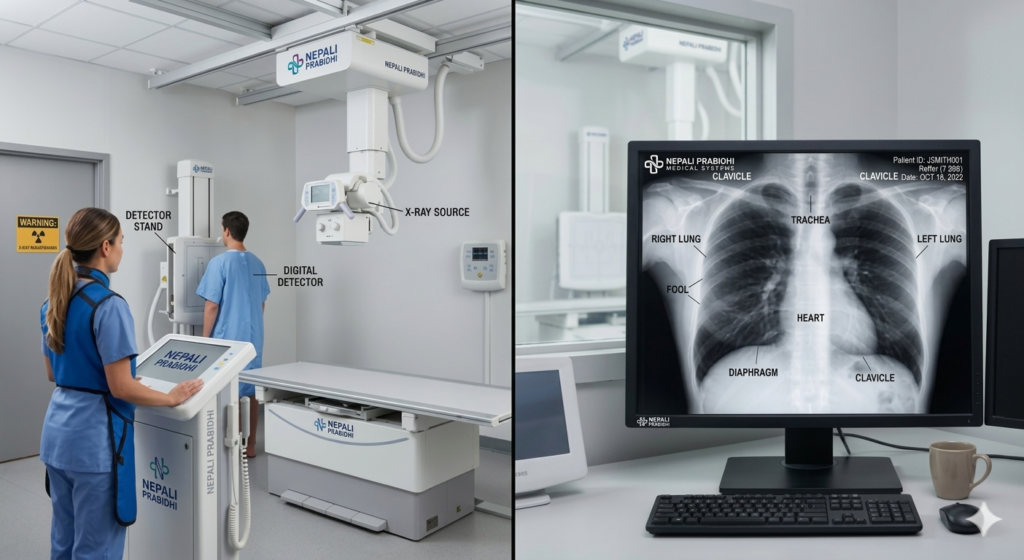
X-Ray Machine in Nepal –
Price, Types, Installation & Suppliers
Introduction – Nepal’s Growing Need for X-Ray Machines
Nepal’s healthcare system is undergoing a meaningful transformation. From major hospitals in Kathmandu to community health posts in Mustang, Jumla, and the Terai, the demand for accurate and reliable diagnostic imaging is growing rapidly — and X-ray machines are right at the heart of it.
Whether it is detecting tuberculosis in a rural clinic, assessing a fracture from a road accident in an emergency ward, or screening for lung conditions in a busy diagnostic center — X-ray machines are essential, every single day.
Yet many facilities across Nepal still face real challenges: outdated equipment, long delivery timelines, poor after-sales support, and uncertainty about which machine to buy. This complete guide covers everything — X-ray machine prices in Nepal, types, installation requirements, licensing, and where to buy in 2026.
What Is an X-Ray Machine?
An X-ray machine is a medical imaging device that uses electromagnetic radiation to create images — called radiographs — of the internal structures of the body. X-ray beams pass easily through soft tissues but are absorbed by denser materials like bones, joints, and implants, producing a contrast image that doctors analyze for diagnosis.
Modern X-ray systems have advanced dramatically from the bulky film-based machines of the past. Today’s digital radiography (DR) systems capture images on flat panel detectors, display results on screen within seconds, and store them digitally — ready to share with specialists anywhere in Nepal or abroad.
For hospitals, clinics, and diagnostic centers in Nepal, investing in the right X-ray machine means faster diagnoses, better patient outcomes, and more efficient daily workflows.
Types of X-Ray Machines Available in Nepal
Depending on your facility’s size, patient volume, and clinical needs, there are several types of X-ray machines available through our radiography range:
1. Analog (Film-Based) X-Ray Machine
The traditional system using X-ray film and chemical processing. While initially affordable, analog machines come with ongoing costs for film, chemicals, darkroom maintenance, and physical storage. Most healthcare facilities in Nepal are now actively replacing these with digital systems.
2. Digital Radiography (DR) System
The gold standard in modern radiology. DR systems use a flat panel detector to capture images digitally, delivering results in under 10 seconds with high resolution and significantly lower radiation dose. Ideal for hospitals and busy diagnostic centers in Kathmandu and major cities.
3. Computed Radiography (CR) System
A practical middle ground between analog and full DR. CR systems use reusable imaging plates that are scanned and processed digitally. They are a popular upgrade path for clinics transitioning away from film without committing to the full cost of a DR setup.
4. Portable X-Ray Machine
Lightweight and often battery-compatible, portable X-ray machines are ideal for health camps, remote clinics, home care visits, and emergency settings. In Nepal’s hilly and mountain districts where patients cannot easily travel to hospitals, portable units — typically 30 mA to 50 mA with wireless DR detectors — are invaluable.
5. Mobile X-Ray Machine (100 mA)
A wheeled unit designed to move between wards within a hospital. Perfect for ICU patients, bedridden patients, and post-operative cases who cannot be moved to a radiology room. The 100 mA mobile system is the most widely purchased model across Nepal’s mid-size hospitals and ICU setups.
6. Fixed High-Frequency X-Ray Machine (100–300 mA)
Permanently installed in a dedicated radiology room, these systems handle high patient volumes and deliver superior image quality. A 300 mA high-frequency setup is the right choice for large hospitals, multi-specialty centers, and busy radiology departments.
7. Dental X-Ray Machine
Designed specifically for intraoral dental imaging — teeth, jaw, and oral structures. Available in handheld and wall-mounted configurations. Browse our dental equipment range for full options.
8. Veterinary X-Ray Machine
With Nepal’s growing veterinary sector, veterinary X-ray units are increasingly in demand — from pet clinics in Kathmandu to rural animal health posts. These machines are optimized for animal anatomy and available in portable and fixed configurations.
9. C-Arm Fluoroscopy Machine
Provides real-time X-ray imaging during surgical procedures — used in operation theaters for orthopedic surgeries, guided injections, and interventional procedures. Essential for any facility performing live imaging during surgery.
X-Ray Machine Price in Nepal (2026)
One of the most common questions from hospital administrators and clinic owners is: “How much does an X-ray machine cost in Nepal?” Below is a realistic price guide for 2026, based on machine type and configuration:
| Machine Type | Approx. Price (NPR) | Best For | Level |
|---|---|---|---|
| Handheld Portable (2–10 mA) | 1.5 – 3 Lakh | Small clinics, health camps | Entry |
| Portable 30–50 mA + Wireless DR | 3.5 – 6 Lakh | Rural clinics, mobile units | Mid |
| 100 mA Mobile X-Ray (Line Frequency) | 5 – 9 Lakh | ICU, wards, clinics | Mid |
| 100 mA High-Frequency Mobile/Fixed + DR | 10 – 15 Lakh | Hospitals, diagnostic centers | Advanced |
| 300 mA Fixed High-Frequency DR System | 25 – 40 Lakh | Large hospitals, radiology depts | Premium |
| Dental X-Ray (Handheld / Wall) | 1.2 – 5 Lakh | Dental clinics | Specialized |
| Veterinary X-Ray Machine | 1.5 – 6 Lakh | Vet clinics, animal hospitals | Specialized |
What Affects the Price of an X-Ray Machine in Nepal?
- mA Rating: Higher mA means faster imaging capacity and higher machine cost
- Technology: High-frequency systems are more efficient and cost more than line-frequency models
- DR Detector Type: Wired vs wireless flat panel detectors affect both image quality and price
- Certifications: AERB, CE, or FDA-certified equipment carries higher quality assurance
- Installation & Training: Professional room setup, shielding, and staff training are part of the total cost
- After-Sales Support: Warranty period, AMC (Annual Maintenance Contract), and spare parts availability
- Import Duties & VAT: Nepal’s customs duties and taxes apply to imported medical equipment
Key Features to Consider Before Buying
Before purchasing an X-ray machine for your hospital or clinic in Nepal, evaluate these critical factors to make sure you choose the right system:
Image Resolution
Look for a flat panel detector with high DPI. A wireless 43×43 cm DR panel is the industry standard for general radiology.
Low Radiation Dose
High-frequency machines emit significantly less radiation per exposure — safer for patients and operators, especially in high-volume settings.
Power Compatibility
Nepal faces voltage fluctuations. Ensure the machine supports 220V ±10% with built-in stabilization or an external stabilizer.
Wireless DR Connectivity
Wireless detectors eliminate cable issues, speed up workflow, and allow flexible patient positioning for different imaging needs.
Local Serviceability
Local spare parts and trained service engineers within Nepal are critical. Great equipment with no local support is a liability.
Certifications
Insist on AERB type-approved, CE, or FDA certified equipment — these ensure regulatory compliance and consistent performance.
Installation Requirements in Nepal
Proper installation of an X-ray machine is not just a technical step — it is a legal and safety requirement in Nepal. Here is what every facility must address before powering on their equipment:
Room Setup Requirements
- Minimum room size of approximately 14 ft × 12 ft for a standard fixed X-ray setup
- Walls, ceiling, and door lined with lead shielding (typically 1–2 mm lead equivalent) to prevent radiation leakage outside the room
- Dedicated electrical line with proper earthing, voltage stabilizer, and circuit breaker
- Controlled access with radiation warning signs on all entry points
- Adequate ventilation and a control booth or barrier for the operator
Radiation Safety for Staff and Patients
- Lead aprons, thyroid shields, and gonad protectors must be available for patients
- TLD (thermoluminescent dosimeter) badges required for all machine operators to monitor radiation exposure
- Only trained radiographers or radiologists should operate the equipment
- Regular quality assurance (QA) testing as per international protocols
Government Registration & Licensing in Nepal
All X-ray machines in Nepal must be registered with the Department of Radiation, Occupational Health and Safety (DoRHS) under the Ministry of Health and Population. Key requirements include:
- Registration of the X-ray unit with DoRHS before clinical use
- Facility radiation safety survey and inspection
- Qualified radiographer or radiologist on staff
- Periodic renewal of registration and compliance reporting
Digital vs Analog X-Ray – A Clear Comparison
If your facility is still running a film-based X-ray system, here is a straightforward comparison that shows exactly why upgrading to digital radiography is the right move for any healthcare facility in Nepal:
| Feature | Analog X-Ray | Digital X-Ray (DR) |
|---|---|---|
| Image Quality | Moderate | High Resolution ✔ |
| Radiation Dose | Higher exposure | Up to 70% lower ✔ |
| Image Availability | 15–20 minutes | Under 10 seconds ✔ |
| Storage | Physical film | Digital / PACS ✔ |
| Film & Chemical Cost | Ongoing ✗ | Zero ✔ |
| Image Enhancement | Not possible ✗ | Brightness & contrast adjustable ✔ |
| Telemedicine Ready | No ✗ | Share instantly ✔ |
| Eco-Friendly | No ✗ | No chemicals needed ✔ |
| Long-Term Running Cost | Higher ✗ | Lower ✔ |
For Nepal’s healthcare facilities — especially those expanding telemedicine to remote districts — digital X-ray systems also enable remote image sharing with specialists in Kathmandu or abroad, dramatically improving diagnostic access for patients in areas far from specialist care.
Why Choose Nepali Prabidhi as Your Supplier
Purchasing an X-ray machine is a significant investment — and the supplier you choose is just as important as the machine itself. In Nepal’s medical equipment market, many buyers struggle with poor after-sales service, lack of trained engineers, and delays in spare parts. We are built to solve exactly those problems.
🏥 Nepali Prabidhi – Authorized Medical Equipment Supplier in Nepal
At Nepali Prabidhi, we are a complete medical equipment solutions provider — not just a supplier. We handle supply, professional installation, calibration, staff training, and long-term after-sales support across Nepal.
We are the authorized dealer in Nepal for StarNuke — an AERB-approved Indian manufacturer known for high-performance, reliable X-ray systems that are well-suited to Nepal’s healthcare environment. This means you get factory-backed quality, genuine parts, and full warranty support through our local team.
- Authorized dealer for certified X-ray and radiography equipment in Nepal
- Professional room assessment, lead shielding guidance, and installation
- Staff training on radiation safety, machine operation, and image management
- DoRHS registration support and full compliance documentation
- Fast spare parts availability and warranty-backed after-sales support
- Coverage across Nepal: Kathmandu, Pokhara, Butwal, Biratnagar, Chitwan, and beyond
Ready to Upgrade Your Radiology Setup?
Free consultation, product demonstration, and competitive quote — anywhere in Nepal.
Frequently Asked Questions
What is the price of an X-ray machine in Nepal?
Is digital X-ray better than analog X-ray?
Do I need a license to operate an X-ray machine in Nepal?
What is the best X-ray machine for a small clinic or health post?
How long does X-ray machine installation take in Nepal?
Where can I buy a certified X-ray machine in Nepal?
What certifications should I look for in an X-ray machine?
Conclusion
X-ray machines are no longer optional — they are a fundamental part of Nepal’s healthcare infrastructure. As the country continues to grow its network of hospitals, clinics, and diagnostic centers, investing in modern digital radiography is one of the most impactful decisions any healthcare facility can make.
Whether you are setting up a new radiology department, replacing an aging analog system, equipping a remote health post, or building a full hospital setup from scratch — the right X-ray machine, properly installed and supported, will serve your patients reliably for years to come.
At Nepali Prabidhi, we are Nepal’s trusted partner for medical imaging equipment — authorized dealers for internationally certified X-ray systems, with a dedicated team for supply, installation, and long-term support across the country.
Get a Free Quote – Anywhere in Nepal
Supply · Professional Installation · Staff Training · After-Sales Support