How to Set Up an X-Ray Room in Nepal: Equipment, Cost & DoHS Compliance Guide 2026
Why Proper X-Ray Room Setup Matters in Nepal
Nepal’s healthcare sector is expanding rapidly. The Ministry of Health and Population registers hundreds of new private hospitals and clinics each year — and diagnostic imaging is now a core requirement for any facility seeking DoHS licensure. An X-ray unit is no longer optional; it is expected.
But installing an X-ray machine is not as simple as buying equipment and plugging it in. Improper setup is one of the most common regulatory violations found during DoHS inspections. Inadequate radiation shielding, unqualified operators, and non-compliant room layouts put both patients and staff at serious risk — and can result in license suspension.
Important: Operating an X-ray machine in Nepal without DoHS and NAST approval is illegal under Nepal’s Public Health Service Act 2075. Non-compliant facilities face equipment seizure and clinic license cancellation.
This guide is designed for hospital owners, clinic administrators, and healthcare procurement managers across Nepal. Also see our complete guide on Pathology Lab Equipment List Nepal for full hospital setup planning.
Nepal Radiology: Key Numbers You Should Know
Understanding the current state of radiology in Nepal helps you see both the opportunity and the urgency of proper, compliant setup from day one.
Most of these resources are concentrated in Kathmandu Valley. For hospitals and clinics in Pokhara, Biratnagar, Butwal, Nepalgunj, and Dhangadhi, there is a significant gap in accessible, compliant radiology services. A properly set-up X-ray unit in a secondary city is both a medical necessity and a strong business investment.
Market Opportunity: Nepal’s medical devices market is projected to reach USD 273 million by 2030. Demand for affordable, portable diagnostic tools is especially strong outside Kathmandu. Setting up now positions your facility ahead of the growth curve.
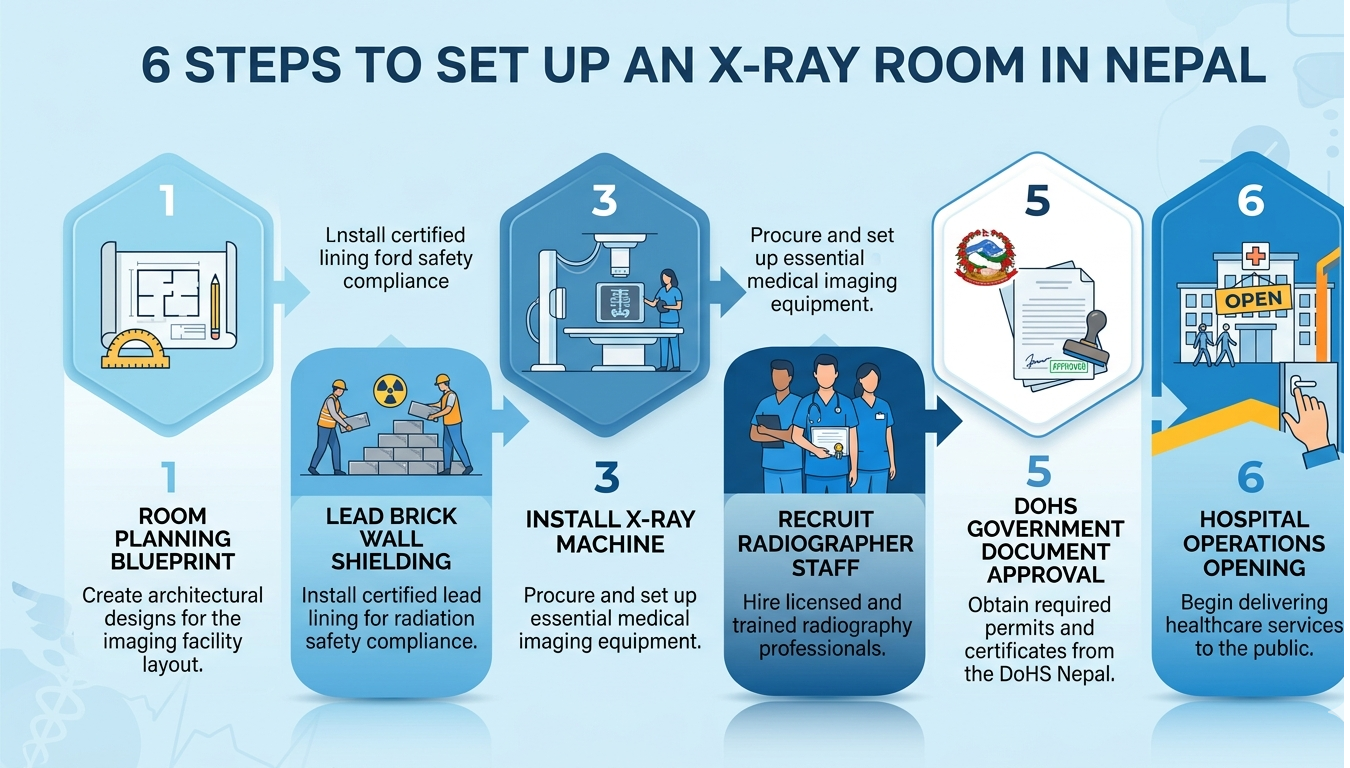
Step-by-Step: How to Set Up an X-Ray Room in Nepal
Follow these six steps in sequence to avoid costly rework and regulatory delays. Skipping or reversing steps is the single most common reason facilities face rejection during DoHS inspection.
Plan Your Room Layout & Location
Choose a room dedicated exclusively to X-ray use. It must not share walls with high-occupancy areas — waiting rooms, children’s zones, or staff offices — unless adequate shielding is installed on both sides. The room must have single controlled access, and a minimum floor area of 15 sq. metres is required by DoHS.
Install Lead Shielding & Civil Infrastructure
All walls, ceiling, and floor must be fitted with at least 0.75 mm lead shielding as per DoHS guidelines. The room must also have a shielded operator control area or booth, proper ventilation, and adequate electrical infrastructure — typically a 3-phase supply for fixed machines.
Select & Purchase Your X-Ray Machine
Choose a machine matched to your daily patient volume and imaging needs. See our equipment guide below for a detailed comparison of machine types and recommended specifications for different facility sizes in Nepal.
Hire Qualified Radiography Staff
Only NHPC-registered radiographers are legally permitted to operate X-ray equipment in Nepal. Ensure your facility has at least one qualified radiographer on-site during all X-ray sessions, and a radiologist available for report interpretation — on-site or via teleradiology.
Apply for DoHS & NAST Approval
Submit your application to the Department of Health Services (DoHS) and NAST for radiation safety clearance. Inspectors will verify room shielding, staff qualifications, and equipment calibration. Allow 30–90 days for this process — do not see any patient until the signed approval letter is in hand.
Commission Equipment & Begin Operations
Conduct a full commissioning test with your radiographer. Set up a patient registration and reporting workflow. Establish a Preventive Maintenance Contract (AMC) with your supplier for annual servicing and calibration — required for DoHS license renewal every year.
Room Size, Shielding & Infrastructure Requirements
Nepal’s DoHS guidelines set minimum standards for X-ray room construction. These are non-negotiable for approval. The table below provides a practical summary for facility planners and civil engineers.
| Requirement | DoHS Minimum | Best Practice (Recommended) |
|---|---|---|
| Room Size | 15 sq. metres minimum | 20–30 sq. metres for comfortable workflow |
| Lead Shielding (Walls) | 0.75 mm lead equivalent | 1.5 mm lead (shared-wall or dense urban areas) |
| Lead Door | Lead-lined door mandatory | Interlocked warning light system on door |
| Operator Control Area | Shielded barrier required | Separate glass-panelled control room |
| Power Supply | Stable electrical supply | 3-phase + UPS/voltage stabiliser |
| Ventilation | Adequate air circulation | Dedicated HVAC; temperature controlled |
| Warning Signage | Radiation hazard signs required | Illuminated “X-Ray In Progress” signs |
| Patient PPE | Lead aprons required | Lead aprons + thyroid shields + gonadal shields |
Urban Nepal Tip: In Kathmandu’s dense commercial zones — Baneshwor, New Baneshwor, Kalanki — rooms sharing walls with adjacent businesses require additional shielding. NAST inspectors assess radiation leakage to adjacent occupied spaces and often require 1.5 mm lead in these situations. Contact Nepali Prabidhi for a site-specific shielding assessment.
Choosing the Right X-Ray Machine for Your Facility
Nepal’s market now offers a full range of X-ray systems — from handheld portable units for remote health posts to large-format digital radiography systems for tertiary hospitals. Use the table below to identify the right fit for your facility type and patient volume.
| Machine Type | Best For | Daily Capacity | Power Needed | Price (NPR) |
|---|---|---|---|---|
| Handheld Portable | Health posts, field hospitals, home care | 10–20 patients | Battery operated | 5L – 12L |
| Mobile DR Unit | ICU, ward, bedside imaging | 20–50 patients | Single phase | 18L – 40L |
| Computed Radiography (CR) | Upgrading existing analog systems | 30–60 patients | Single / 3-phase | 20L – 50L |
| Fixed Digital DR | Hospitals, polyclinics, diagnostic centres | 60–120+ patients | 3-phase mandatory | 40L – 1Cr+ |
| High-Freq Fixed (600–1000mA) | Trauma centres, teaching hospitals | 100–200 patients | 3-phase + UPS | 60L – 1.5Cr+ |
Key Specifications to Check Before Buying
- Tube Current (mA): Higher mA = faster imaging and better image quality. Minimum 300mA for hospital use.
- Flat Panel Detector (FPD) size: 43×43 cm for general radiography; 35×43 cm for chest-focused work.
- DICOM compatibility: Must integrate with your Hospital Information System (HIS) and support teleradiology.
- Radiation dose display: Required for patient dose monitoring and DoHS compliance.
- Warranty and AMC: Minimum 2 years warranty; confirm spare parts availability in Nepal.
- Service centre: Verify the supplier has a certified service engineer based in Nepal.
Nepali Prabidhi supplies hospital-grade diagnostic equipment across Nepal with full installation, staff training, and DoHS documentation support included. Also see our Hospital Furniture Nepal guide to plan your complete radiology room setup.
Complete Cost Breakdown: X-Ray Room Setup in Nepal (2026)
The total cost involves far more than just the machine. Here is a comprehensive breakdown so you can plan your budget accurately from day one — covering civil work, regulatory fees, PPE, and training.
| Cost Component | Small Clinic | Mid-Size Hospital | Large / Teaching Hospital |
|---|---|---|---|
| X-Ray Machine | NPR 10L – 20L | NPR 35L – 60L | NPR 60L – 1.5Cr+ |
| Lead Shielding & Civil Work | NPR 2L – 5L | NPR 6L – 15L | NPR 15L – 35L |
| Electrical Upgrade (3-phase, UPS) | NPR 50K – 2L | NPR 2L – 6L | NPR 6L – 15L |
| Lead Door & Warning Signage | NPR 80K – 1.5L | NPR 1.5L – 3L | NPR 3L – 6L |
| Radiation Safety PPE | NPR 30K – 80K | NPR 80K – 2L | NPR 2L – 5L |
| DoHS / NAST Fees & Documentation | NPR 20K – 50K | NPR 50K – 1L | NPR 1L – 2L |
| Staff Training | NPR 10K – 30K | NPR 30K – 1L | NPR 1L – 2L |
| Total Estimated Setup Cost | NPR 14L – 30L | NPR 45L – 90L | NPR 90L – 2.5Cr+ |
Cost-Saving Tip: Refurbished digital X-ray machines from certified suppliers cost 20–40% less than new units and can include full DoHS-compliant specifications. Always verify tube life hours, detector condition, and warranty before purchasing. Contact Nepali Prabidhi for refurbished options with full warranty and nationwide service support.
DoHS & NAST Compliance: Complete Checklist
Regulatory compliance is the foundation of legal X-ray operation in Nepal. Use this checklist to track exactly what your facility must complete at each stage.
Before Installation
- Register your health facility with DoHS under the Ministry of Health and Population (MoHP)
- Get building clearance from the local municipality for X-ray room construction
- Submit room layout, shielding design, and equipment specifications for pre-approval review
- Confirm NHPC-registered radiographer is hired and on payroll
After Installation — Before Operations
- Apply to NAST for radiation safety inspection and site clearance
- Apply to DoHS for X-ray operation permit (separate from your clinic registration)
- Pass NAST site inspection: shielding verification, radiation leakage test, equipment calibration check
- Obtain signed approval letter from DoHS before seeing any patient
- Display approved radiation warning signs and occupancy notices at all entry points
Ongoing Compliance (Annual)
- Annual maintenance and calibration of X-ray equipment — required for license renewal
- Radiation dosimeter monitoring for all X-ray staff with maintained records
- Annual DoHS renewal with updated staff credentials and equipment service records
- Maintain patient X-ray log book: date, patient ID, body part, dose — required by DoHS
5 Costly Mistakes to Avoid When Setting Up an X-Ray Room in Nepal
Buying the Machine Before Planning the Room
Many clinics purchase equipment first — then discover the room is too small, the walls need more shielding, or the electrical supply is inadequate. Plan the room and get a shielding assessment first, then select equipment that matches your room specifications and power capacity.
Choosing Lowest Price Over Total Cost of Ownership
A cheap machine with no local service centre and a short warranty will cost far more over three years than a slightly higher-priced machine backed by proper AMC support. Nepal has seen cases where imported low-cost machines sat non-functional for months waiting for replacement parts.
Operating Before DoHS Approval is Received
Some clinics begin imaging patients while approval is “in process.” This is illegal and has resulted in clinic shutdowns and equipment seizures. Do not see a single X-ray patient until you hold the signed DoHS and NAST approval documents in hand.
Skipping Staff Radiation Safety Training
Nurses and assistants positioning patients are frequently exposed to radiation. Ensuring all staff wear dosimeters, maintain safe distance, and know when to use lead protection is both a legal requirement and an ethical obligation — not just the radiographer’s responsibility.
No DICOM or HIS Integration Plan
Modern hospitals in Nepal are moving toward digital patient records. An X-ray machine without DICOM support cannot integrate with your Hospital Information System (HIS), making image storage, retrieval, and teleradiology sharing difficult. Always verify DICOM compatibility before purchasing.
Frequently Asked Questions About X-Ray Room Setup in Nepal
The total cost ranges from NPR 14 lakh to 30 lakh for a small clinic, NPR 45–90 lakh for a mid-size hospital, and NPR 90 lakh to 2.5 crore+ for a large or teaching hospital. This covers the machine, lead shielding, civil work, electrical upgrades, PPE, regulatory fees, and staff training. See our full cost breakdown above.
Yes — absolutely mandatory. Every facility operating an X-ray machine must obtain written approval from the Department of Health Services (DoHS) and pass a site inspection by NAST for radiation safety clearance. Operating without these approvals is illegal and can result in equipment seizure and clinic closure under Nepal’s Public Health Service Act 2075.
Nepal’s DoHS regulations mandate a minimum of 0.75 mm lead equivalent shielding in all X-ray room walls, ceilings, and floors. For facilities in densely occupied buildings — or with adjacent patient waiting areas — 1.5 mm lead shielding is strongly recommended to pass NAST’s radiation leakage tests comfortably.
For a small clinic handling 20–50 patients per day, a 100mA–300mA mobile digital X-ray unit or a portable DR system is the most cost-effective and space-efficient option. It requires single-phase power, less civil shielding investment, and handles chest, bone, and abdominal imaging comfortably. Contact Nepali Prabidhi for a free consultation on the right machine for your specific patient volume.
From complete application submission to receiving your final approval, expect 30 to 90 days. This includes document review, NAST site inspection scheduling, radiation leakage testing, and formal approval letter issuance. Incomplete applications, missing staff credentials, or shielding failures will significantly extend this timeline. Working with an experienced equipment supplier who handles documentation support can reduce the process by 2–3 weeks.
Yes — refurbished X-ray machines are permitted in Nepal, provided they meet DoHS and NAST technical standards. Refurbished systems typically cost 20–40% less than new ones. Before purchasing, always verify the tube’s remaining life hours, detector condition, last calibration date, and whether the supplier can provide warranty and spare parts service in Nepal.
Only NHPC (Nepal Health Professional Council) registered radiographers or radiologic technologists are legally authorised to operate X-ray equipment in Nepal. The facility must also have a qualified radiologist available for report interpretation — either on-site or through a teleradiology arrangement. Employing unqualified staff to operate X-ray machines is one of the most common violations found during DoHS inspections.
DICOM (Digital Imaging and Communications in Medicine) is the international standard for storing and transmitting medical images. A DICOM-compatible X-ray machine allows digital image storage, seamless sharing via teleradiology, integration with your Hospital Information System (HIS), and easy retrieval of historical patient images. For any hospital in Nepal planning for growth beyond 50 patients per day, DICOM compatibility is essential — not optional.
Ready to Set Up Your X-Ray Room in Nepal?
Nepali Prabidhi supplies hospital-grade X-ray machines across Nepal with full installation, DoHS documentation support, staff training, and Annual Maintenance Contract. Get a free site assessment and equipment quote today.